All official European Union website addresses are in the europa.eu domain.
See all EU institutions and bodies
Do something for our planet, print this page only if needed. Even a small action can make an enormous difference when millions of people do it!

All official European Union website addresses are in the europa.eu domain.
See all EU institutions and bodiesAir pollution is a local, pan-European and hemispheric issue. Air pollutants released in one country may be transported in the atmosphere, contributing to or resulting in poor air quality elsewhere.
Particulate matter, nitrogen dioxide and ground-level ozone, are now generally recognised as the three pollutants that most significantly affect human health. Long-term and peak exposures to these pollutants range in severity of impact, from impairing the respiratory system to premature death. Around 90 % of city dwellers in Europe are exposed to pollutants at concentrations higher than the air quality levels deemed harmful to health. For example, fine particulate matter (PM2.5) in air has been estimated to reduce life expectancy in the EU by more than eight months. Benzo(a)pyrene is a carcinogenic pollutant of increasing concern, with concentrations being above the threshold set to protect human health in several urban areas, especially in central and eastern Europe.
Air pollution is causing damage to human health and ecosystems. Large parts of the population do not live in a healthy environment, according to current standards. To get on to a sustainable path, Europe will have to be ambitious and go beyond current legislation.
Hans Bruyninckx, EEA Executive Director
Air pollution also damages our environment.
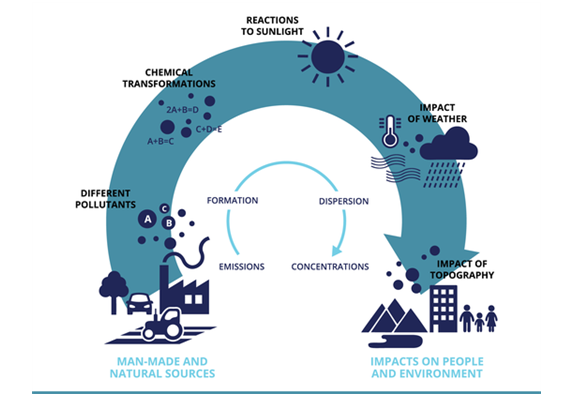
Source: EEA Signals 2013
Europe's air quality has not always improved in line with the general decrease of anthropogenic (human-caused) emissions of air pollutants. Reasons for this are complex:
Targeted efforts to reduce emissions are therefore still required to further protect human health and the environment in Europe.
There are various sources of air pollution, both anthropogenic and of natural origin:
The EU's long-term objective is to achieve levels of air quality that do not result in unacceptable impacts on, and risks to, human health and the environment. The EU acts at many levels to reduce exposure to air pollution: through legislation; cooperation with sectors responsible for air pollution, as well as international, national and regional authorities and non-governmental organisations; and research. EU policies aim to reduce exposure to air pollution by reducing emissions and setting limits and target values for air quality. In late 2013, the European Commission adopted a proposed Clean Air Quality Package including new measures to reduce air pollution.
Find out more about European air pollution policies
The European Environment Agency (EEA) is the European Union's air pollution data centre; it supports the implementation of EU legislation linked to air emissions and air quality. The EEA also contributes to the evaluation of EU air pollution policies and to the development of long-term strategies to improve air quality in Europe.
EEA's work focuses on:
Find out more about EEA activities
The EEA has published a collection of air pollution links.
For references, please go to https://www.eea.europa.eu/themes/air/intro or scan the QR code.
PDF generated on 01 Jul 2025, 07:52 PM
Engineered by: EEA Web Team
Software updated on 26 September 2023 08:13 from version 23.8.18
Software version: EEA Plone KGS 23.9.14
Document Actions
Share with others