All official European Union website addresses are in the europa.eu domain.
See all EU institutions and bodies
An official website of the European Union | How do you know?
Environmental information systems
EN


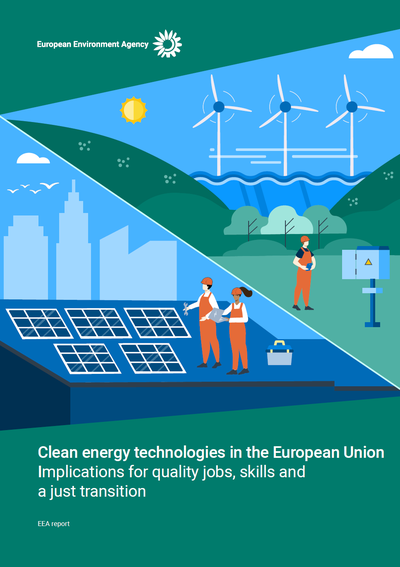
Europe is investing heavily in clean energy technologies and this is reflected in the job market, shows the report 'Clean energy technologies in the European Union — Implications for quality jobs, skills and a just transition', recently published by the European Environment Agency. We talked with Martina Bisello, expert on sustainability transitions and justice, about the report and its findings.
Are new jobs being created in the clean energy technologies?
The clean energy transition is already creating many jobs and the overall direction is clearly one of growth. Our analysis estimates that close to one million people were directly employed in the EU clean-energy technology sector in 2023.
Looking specifically at wind energy, solar photovoltaics, heat pumps and batteries, wind was the largest employer, with around 273,500 direct jobs in 2023 — 77% of which is in operational activities: maintenance, energy contracting, sales administration. This reflects the large installed base and the continuing need to operate and maintain wind infrastructure. Solar PV comes in second, with approximately 227,300, out of which 36% works in construction.
Heat pumps currently employ fewer people, with an estimated 80,100 workers based on our modelling approach, but they offer considerable growth potential. Batteries have the smallest workforce of the four sectors, at around 33,000 people in 2023, but they recorded the fastest employment growth. Most existing battery jobs are in manufacturing, while research and development remains strategically important for next-generation technologies.
Expert on sustainability transitions and justice
Looking ahead, all four technologies could each employ hundreds of thousands of people by 2030. However, the key message is not simply that more jobs will be created. We also need to consider where these jobs are located, who can access them, and whether they offer fair pay, secure contracts, training opportunities and safe working conditions.
Which skills are most urgently needed to fulfill Europe's climate and competitiveness goals?
The most urgent shortages are in technical and vocational occupations — which are key to the deployment of these technologies. Building electricians are in particularly short supply, with 21 Member States reporting shortages. Twenty Member States report shortages of plumbers and pipe fitters. Gaps are also widespread among electrical mechanics and fitters, electrical engineering technicians, and machinery mechanics.
These workers are essential because clean technologies cannot be deployed without people who can install, connect, operate and maintain them. A shortage of installers, for example, can delay projects and create knock-on effects for manufacturing and investment. Without a faster expansion of vocational education, apprenticeships, reskilling and lifelong learning, workforce bottlenecks could slow progress towards Europe’s climate targets and weaken the competitiveness of its clean-tech industries.
Women and young people remain underrepresented. Why does this matter?
This matters both for fairness and for Europe’s ability to meet growing labour demand. Women account for only 14% of the heat-pump workforce, 22% in solar PV and around 26% in wind and batteries. At the same time, gender imbalances persist not only in overall employment, but also in leadership positions. With regards to young people aged 15 to 24, they account for only 6% to 7% of employment across the wind, solar PV and heat-pump value chains.
The benefits of the transition are not being shared equally. They also leave a large pool of potential talent untapped at a time of widespread labour shortages and an ageing workforce. Action is needed throughout the education-to-employment pathway: more inclusive vocational and STEM education, apprenticeships, mentoring and visible role models, alongside recruitment, retention and career-progression practices that support a more diverse workforce. Improving job quality is equally important, because people will not enter or remain in these sectors unless the jobs are attractive, safe and sustainable.
Which countries account for most of these new jobs?
Countries and regions with established industrial capabilities, infrastructure, skilled workers and innovation ecosystems are currently best positioned to benefit. Germany has the largest absolute workforces in wind energy, solar PV and batteries. Denmark is an important hub for wind manufacturing, while Hungary and Poland are emerging as rapidly growing battery-manufacturing centres. Portugal has the largest heat-pump workforce, followed by Spain and Italy in absolute terms.
However, existing strengths can reinforce geographical concentration. Regions dependent on carbon-intensive industries, or those with weaker infrastructure and training capacity, may find it more difficult to attract new investment. Policymakers therefore need place-based strategies that connect clean-tech investment with regional economic diversification, infrastructure, education and skills development. Targeted support for workers and territories undergoing industrial restructuring, together with strong local participation and social dialogue, can help ensure that clean-tech expansion reduces rather than deepens existing regional inequalities.
How can Europe build a strong clean-tech workforce?
Multiple technologies compete for the same limited pools of skilled technical workers. Europe needs to attract more people into technical and vocational occupations that are critical to the clean-energy transition.
Making these careers more attractive will require improving their visibility, strengthening vocational education and apprenticeships, and ensuring good working conditions, career prospects and quality jobs. At the same time, greater mutual recognition of qualifications across countries could help workers move more easily across borders.
Finally, workforce policies should be inclusive and place-sensitive. More needs to be done to attract women and young people into the sector, support job to job transitions and workers in declining industries, and ensure that all regions can benefit from the opportunities created by the clean-energy transition.
Was there a finding in the report that surprised you?
What struck me most was how different parts of the clean-tech value chain contribute to employment. Policy discussions often focus on manufacturing capacity, and rightly so, because a strong industrial base is essential for Europe’s competitiveness, strategic autonomy and economic resilience. At the same time, the EEA report shows that employment opportunities are distributed across the entire value chain and that large numbers of jobs are also created in construction, installation, operations and maintenance.
In turn, this is reflected in the diversity of occupations involved in the transition, ranging from engineering professionals, electrical and electrical and electronic equipment assemblers, and building and related electricians, to production clerks and other business-support roles.
This highlights that the success of the clean-energy transition depends not only on producing clean technologies in Europe, but also on attracting, training and retaining a diverse workforce with different skills and qualification levels. Many of these occupations are already experiencing labour shortages. Ensuring that the workforce is available across the entire value chain will therefore be just as important as strengthening manufacturing capacity.