All official European Union website addresses are in the europa.eu domain.
See all EU institutions and bodies
An official website of the European Union | How do you know?
Environmental information systems
EN


What impacts are air, noise, chemical pollution having on our mental health? And, related to this, what impacts are pollution levels having on children, elderly and less well-off living in our cities? The EEA has recently published a briefing on pollution and mental health and is working on another one looking at vulnerable populations in European cities. We sat down with Gerardo Sanchez, environment, health and well-being expert and Jeanne Vuaille, environment and health data analysis expert to discuss this topic for an EEA podcast.
Gerardo: What is the connection between higher levels of pollution with higher levels of mental health issues?
Mental health problems arise from a complex interplay of factors, which we still don’t fully understand. Genetics, socioeconomic conditions, lifestyle, and early life experiences all influence mental health, making it difficult to isolate the contribution of any single risk factor.
But pollution is one of those risk factors, and this is probably news for many, with increasingly solid evidence showing that environmental stressors can aggravate symptoms, trigger episodes, or contribute to the development of mental health disorders, particularly when exposures occur during sensitive developmental periods such as childhood or pregnancy.
What links are made with air, noise and chemical pollution?
The strongest and most consistent evidence links air pollution with mental health issues. In the long term, exposure to fine particulate matter (PM2.5) and nitrogen dioxide (NO₂ ) is linked with depression, both the onset and worsening of depressive symptoms. But short-term pollution peaks are also associated with exacerbation of the symptoms of schizophrenia, and in some cases anxiety and bipolar symptoms.
Similarly, for noise, moderate evidence supports associations between road traffic or aircraft noise and adult depression, as well as behavioural problems in children. In these cases, noise-related stress and sleep disruption are thought to play key roles.
EEA
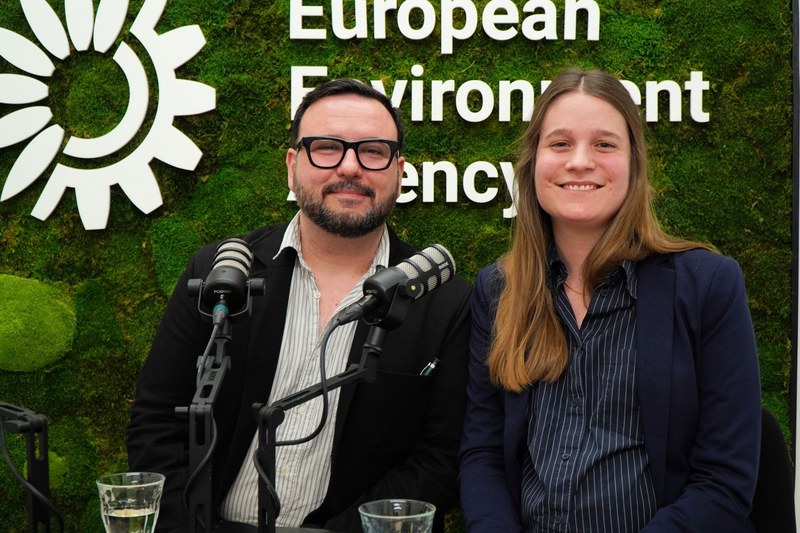
EEA experts Gerardo Sanchez and Jeanne Vuaille
Evidence for other pollutants is emerging but less consistent. For example, we have known for a long-time that certain chemicals, such as lead, are linked to mental health problems. Studies link both lead and second-hand smoke to depression and schizophrenia, especially when exposure occurs prenatally or in early childhood. For other substances — including endocrine disruptors like BPA and phthalates — the evidence is more mixed, with studies being less consistent across populations.
What does our recent briefing say about the links between pollution and mental health?
We have recently published the EEA briefing 'Pollution and mental health: current scientific evidence', based on a comprehensive report that has been released at the same time, shows that although evidence linking pollution and mental health is growing, science has not yet established definitive causal links. This is mainly because most studies are cross-sectional, meaning they look at one population at one point in time, like a snapshot. So they show associations but cannot yet prove a cause-and-effect relationship.
We need more long-term, developmental studies that follow people over time to pinpoint when and how pollution affects mental health. It’s important to note that links that are well established today, like that of air pollution and cardiovascular disease, were at some point also a hypothesis at an early stage.
Jeanne, how does this link to EEA work on environmental inequalities?
These findings can be directly linked to our work on environmental inequalities where we also look at how pollution impacts Europeans and particularly more vulnerable groups like children, the elderly or those with lower incomes. We know that some Europeans are more exposed to air pollution than others, and this leads to unequal health impacts including mental health related issues.
Starting at the high-level regional scale, we know for instance that regions in southeastern Europe have on average higher fine particulate matter levels than northwestern regions, while being poorer in terms of GDP per capita. So, while being more polluted, these regions have potentially also less capacity to address pollution issues.
What about the city level?
If we zoom in at the city level, where the highest particulate matter concentrations can be found, we also see differences across neighbourhoods. However, not all people react to pollution in the same way, some are more sensitive to pollution, like older people, children and people who are already sick, and for them, the health burden will be even greater.
Some people might experience unequal impacts also because they have less ability to act, for example by demanding or or influencing local urban plans that can help with mitigating air and noise pollution, or because they have less capacity to relocate for economic reasons. It can also simply be because of language barriers or education level that reduce environmental awareness and understanding of how to engage in local, political actions.
We also know that we are not exposed to only one environmental stressor at the same time. They could also be exposed to noise pollution or extreme heat due to climate change.
In terms of climate change impacts, we have evidence that simultaneous exposure to air pollution and extreme heat leads to significantly increased health risks compared to either one alone. We have a specific web pageon this particular topic.
Therefore, we are increasingly trying to look at the combined effects of those stressors, especially for more vulnerable groups.
Do differences in air pollution and noise coincide with the presence of certain groups in urban areas?
We recently looked at city areas where we see both higher pollution levels and a higher proportion of certain population groups, to understand, for each EU country, whether some groups are disproportionately exposed to air pollution and where exactly in the cities, as this can help inform local urban plans.
We don’t yet have definite conclusions, but the preliminary analysis shows that across countries, there are some more polluted neighbourhoods where the proportion of older people, children, unemployed and foreign-born is also higher, leading to a disproportionate exposure for these groups. We are also carrying out similar analyses in terms of exposure to high noise levels and access to green and quiet areas.
Why is this important to highlight?
Highlighting unequal exposure patterns, especially at the city level, is important for informing upstream political measures which can effectively address structural inequalities in urban planning and residential sector.
We know that a healthier population is a more resilient population. So we need to ensure the same level of protection for all Europeans, and that nobody is left behind.
Therefore, our work focuses on highlighting, addressing both unequal exposure and unequal impacts.
What is being done in these areas to address these challenges?
Gerardo: The EU has extensive regulation to reduce air pollution, to reduce environmental noise and to reduce exposure to toxic chemicals. However, the situation is different depending on the type of environmental exposure.
For air pollution, we have seen a steady decrease in concentrations, but we haven’t seen a clear improvement in the levels of environmental noise. And on chemicals, it is just an overwhelming amount of chemicals to look into and appraise.
The most important thing now is to ensure implementation of the EU regulations against pollution and achieve the targets of the Zero Pollution Action Plan. Also, the nature restoration law aims at increasing the presence of green spaces in urban areas, which could help increase contact with nature and its associated mental health benefits.
And Jeanne, what about actions addressing vulnerable groups?
Our ongoing work on environmental inequalities aims to support actions for vulnerable groups under the recently revised Ambient Air Quality Directive which, for the first time, specifically defines sensitive population and vulnerable groups.
It includes obligations for Member States including ensuring specific measures in air quality plans, roadmaps to protect these populations and public consultations that include involvement of representative organisations from these groups.
EEA
EEA podcasts
The coming EEA ‘Europe's climate and environment’ podcast episode on pollution, mental health and vulnerable groups will air in the coming month. The EEA podcast is available wherever you download and listen to your favourite podcast shows.