All official European Union website addresses are in the europa.eu domain.
See all EU institutions and bodies
An official website of the European Union | How do you know?
Environmental information systems
EN


People, nature and the economy all need water and water is many things: a vital need, a local and global resource, a transport corridor, a climate regulator and home and provider to many species. Yet Europe's rivers, lakes, seas and groundwater are under pressure from pollution, excess nutrients from farming and wastewater, overuse and climate change.
From melting glaciers, lakes, and rivers to ground water and seas, water is an interconnected and vital resource. Pollution, over-exploitation, physical alterations to water habitats and climate change continue to impact Europe's water bodies and life dependent on them.
Freshwater resources are finite. Europeans use billions of cubic metres of water every year for drinking, farming, manufacturing, heating and cooling, electricity generation, tourism and other service sectors. Population growth, urbanisation, pollution and the effects of climate change, such as persistent droughts, are putting a growing strain on Europe’s freshwater supplies and its quality.
Europe’s seas cover more than 11 million km2 and range from shallow, semi-enclosed seas to vast expanses of the deep ocean. They host a wide and highly diverse range of coastal and marine ecosystems with a large variety of habitats and species. Even though EU countries have managed to reduce some pressures, the conservation status of marine ecosystems also remains critical. Similarly, pollution, over-exploitation of marine resources and economic activities also impact marine life.
The European Union and its Member States have been putting in place policies and measures to improve water quality, reduce pollution and improve the state of aquatic ecosystems. In some cases, like the bathing water quality, drinking water and urban wastewater treatment, there have been remarkable achievements. In other areas, such as conservation of wetlands, plastic litter in seas, the latest trends continue to cause concern.
Press releases and articles
Publications
Indicators
Maps and charts
Datahub
Info pages
Frequently asked questions
Tracking antimicrobial resistance in Europe’s waters
Antimicrobial resistance (AMR) does not stop at hospitals or farms. Resistant bacteria, resistance genes and antimicrobial residues can enter rivers, lakes and coastal waters through wastewater, industry and agriculture, where they can persist and spread.
This EEA briefing looks at what antimicrobial resistance in surface waters and urban wastewater means for public health, and why better environmental monitoring is needed to close an important gap in Europe’s One Health response.
Mila Penkova, WaterPIX /EEA

Jael Coon on Unsplash
How water-saving measures can ensure the EU’s water resilience
The EU can achieve significant water savings by improving efficiency in the sectors that use the most — including agriculture, energy, and public water supply. Since 2010, water abstraction has increased across nearly all sectors except electricity cooling, adding pressure to scarce water resources.
Climate change intensifies these pressures and makes water availability more unpredictable. Water efficiency is key to ensuring future supply and strengthening resilience to growing demand and seasonal shortages.
Climate change and water: Too much or too little?
Climate change has many significant impacts on water. One of these impacts is the amount of water that will be at a given place at a given time. As our climate is changing, some areas are projected to get wetter.
Heavy rain downpours might result in flooding as there is more water than the ground can absorb. Other areas are expected to get drier, increasing the risk of water scarcity and drought.

Małgorzata Kucharska, REDISCOVER Nature/EEA
Europe's seas: Interested in their state, pressures affecting them and what is being done to protect them?
ImageArkadiusz Srebnik, Well with Nature/EEA
How can Copernicus help?
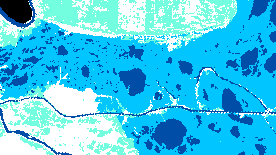
Our drinking water, our economies, our food systems and an increasing amount of energy generation depend on a detailed knowledge of water resources. Understanding the location and characteristics of water bodies is therefore essential. The Copernicus Land Monitoring Service provides data to monitor water bodies, wet surfaces, snow and ice across Europe.
Copernicus water products support water management, risk assessment and a better understanding of Europe’s water resources.
CLMS