All official European Union website addresses are in the europa.eu domain.
See all EU institutions and bodies
An official website of the European Union | How do you know?
Environmental information systems
EN


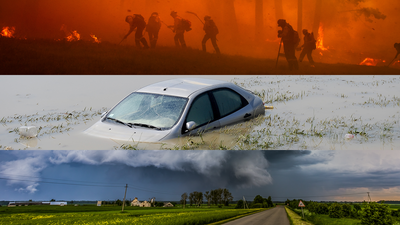
Weather- and climate-related extremes caused economic losses estimated at around EUR 920 billion in the European Union between 1980 and 2025, of which more than EUR 270 billion occurred in the last five years alone, according to an indicator published today by the European Environment Agency (EEA). As extreme events are expected to intensify with climate change, these losses are likely to keep rising.
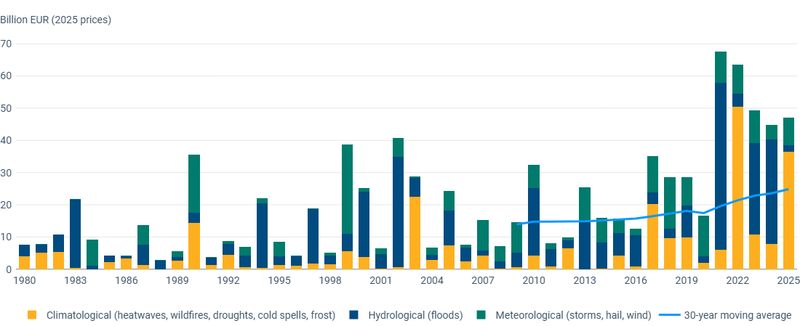
2026 is already a year of heavy losses due to weather and climate-related extremes: storms, heatwaves, droughts have affected Europe’s economy heavily. And the year is not over yet. The latest indicator published by the EEA, on Economic losses from weather- and climate-related extremes in Europe, shows that losses have intensified in recent years: almost a third of all losses recorded over the past 45 years occurred between 2021 and 2025. All values are direct losses (not including indirect economic losses like loss of productivity and/or GDP, environmental impacts and impact on people’s health), calculated at 2025 euro values.
The first European Climate Risk Assessment (EUCRA) concluded that climate risks are accelerating and that cascading risks can create system-wide challenges for whole societies. Extreme events are expected to intensify further, while adaptation is not keeping pace. For example, EUCRA estimates losses of at least EUR 175 billion a year for the EU and the UK, at 3°C of global warming.
The future cost of climate-related hazards will depend on how often and how severely events occur, and on other factors such as the value of the assets exposed and the effectiveness of adaptation measures.
Figure 1. Annual economic losses caused by weather-and climate-related extreme events in the EU Member States
Where losses are highest
Floods account for 44% of the losses from 1980 to 2025. Climatological events like drought, cold spell, frost (but excluding heatwave and wildfire) and meteorological events (storm, lightning, excluding hail) account for one fourth of the total each. Wildfire, hail and heatwave together account for around 5% of direct economic losses.
Relatively few events were responsible for most of the economic losses: 5% of climate-related events with the biggest losses were responsible for 63% of losses, and 1% of the events caused 31% of losses.
The economic impact of climate-related extremes varies across the EU. In absolute terms, the highest economic losses during the period 1980-2025 were recorded in Germany, Italy and France. Highest losses per capita in the EU were calculated in Slovenia, Spain and Luxembourg and the highest losses per area were found in Slovenia, Belgium and Luxembourg.
According to estimates for 1980-2025, less than 20% of total losses were insured in the EU. This varied among countries, from less than 2% in Bulgaria, Cyprus and Romania, to over 60% in Denmark and Luxembourg.
Eu action on climate resilience
The 2021 EU Adaptation Strategy and the EU Framework for Climate Resilience, presented by the European Commission in October 2026, aim to build resilience, prepare the EU to manage climate risks and reduce losses from weather- and climate-related events. The framework includes a proposal for a European Climate Resilience Law and a set of practical tools. They are meant to help the EU move from reacting to disasters towards anticipating climate impacts and preventing avoidable damage.