All official European Union website addresses are in the europa.eu domain.
See all EU institutions and bodies
An official website of the European Union | How do you know?
Environmental information systems
EN


Sales of electric trucks are accelerating in Europe, although electric models still make up only a small share of new trucks registered. New assessments published today by the European Environment Agency (EEA) show that scaling up electric trucks will depend on charging infrastructure and electricity grids keeping pace. Electrification must go hand in hand with a shift to more energy-efficient modes such as rail, to cut emissions and reduce Europe's dependence on imported fossil fuels.
The EEA briefing 'Where the road meets the wire: electrifying heavy-duty vehicles in Europe' is published together with the EEA report 'Sustainability of Europe's mobility systems' and a series of EEA indicators on transport and mobility.
Transport accounts for around a third of EU greenhouse gas emissions, including international aviation and shipping, and road transport alone for more than 72% of transport emissions. Moving away from fossil fuels in transport matters for Europe's climate goals and for its energy security and competitiveness. Road transport remains heavily dependent on fossil fuels, with only 7% of its energy coming from renewable sources or electricity.
Replacing diesel with electricity can reduce reliance on imported fossil fuels and exposure to volatile global fuel markets, while supporting new European industrial value chains. At the same time, it will require resilient electricity grids and more secure and diversified battery and raw material supply chains. But electrification will also increase demands on electricity grids and requires secure and diversified battery and raw-material supply chains.

Trucks pick up speed while buses lead the way
Getting heavy-duty vehicles, including trucks, buses and coaches, off diesel is crucial. Their greenhouse gas emissions were more than a quarter higher in 2024 than in 1990, and they use about 42% of the diesel consumed by EU road transport.
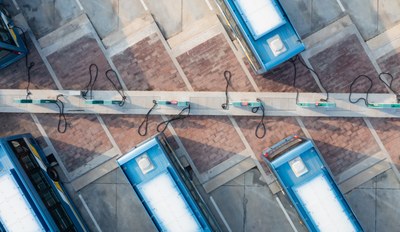
Electric city buses show what is possible: they reached almost 60% of new sales in 2025. City buses are particularly well suited to electrification because they operate predictable routes and schedules, can recharge at central depots, and their uptake can be accelerated through public procurement of entire fleets. Trucks are starting to follow. Electric truck registrations grew by 66% in 2025, reaching 4.2% of new medium and heavy trucks. Electric medium trucks already account for more than 20% of new sales, while electric heavy trucks remain below 2%.
According to the EEA briefing, for many urban and regional operations the question is no longer whether electric trucks can do the job, but whether they can be run economically and reliably. Total cost of ownership, access to charging and grid connections are becoming decisive.
Charging and grids hold the key
Most urban and regional operators are expected to rely on charging at their own depots, while long-haul freight will need high-power public charging along major routes. Public charging for trucks is expanding fast, with the number of charging points rising by almost 60% in the first half of 2026. Yet only around 3% of the trans-European transport network currently meets EU requirements for heavy-duty vehicle charging.
Scaling up will take more than installing chargers. Suitable locations, sufficient grid capacity and timely connections will be needed, requiring close coordination between transport operators, charging providers, grid operators and public authorities.
Cars and vans further ahead
The shift is most visible in passenger cars. More than one in four new cars registered in the EU in 2025 was electric, led by battery electric models, and public charging now covers 73% of the trans-European transport network for cars and vans. Electric vans are growing too, but still made up only 11.2% of new van registrations in 2025.

Just electrification will not be enough
Cleaner vehicles alone will not make Europe's transport system sustainable. Europe is moving more people and goods than ever: freight activity was around 40% higher in 2024 than in 1995, offsetting part of the gains from cleaner vehicles and fuels. Yet the share of rail and inland waterways in inland freight transport fell from 27% in 2012 to 22% in 2024. Reversing this trend, alongside electrification and better logistics, can cut energy use, emissions and air pollution.
Aviation and maritime transport will also require efficiency improvements and greater use of sustainable renewable and low-carbon fuels where direct electrification is difficult.
Other pressures remain too. As exhaust emissions fall, pollution from tyres, brakes and road wear is becoming more important, and more than 20% of people in the EU are exposed to harmful levels of transport noise.
Assessments included in this package
Report: Sustainability of Europe's mobility systems 2026
Briefing: Where the road meets the wire — electrifying heavy-duty vehicles in the EU
Indicators:
- New registrations of electric cars in Europe
- New registrations of electric vans in Europe
- Emissions of air pollutants from transport in Europe
- Share of trains and inland waterways in freight transport in Europe