All official European Union website addresses are in the europa.eu domain.
See all EU institutions and bodies
An official website of the European Union | How do you know?
Environmental information systems
EN


EEA report 14/2026
Europe's industrial transformation challenge is now less about developing new technologies and more about deploying them at scale. While many industrial facilities already use viable low-carbon and circular technologies, wider uptake depends on policy certainty and the availability of enabling conditions such as the right infrastructure and clean and affordable energy.
EN PDF: TH-01-26-043-EN-N - ISBN: 978-92-9480-795-3 - ISSN: 1977-8449 - doi: 10.2800/9237455
Key messages
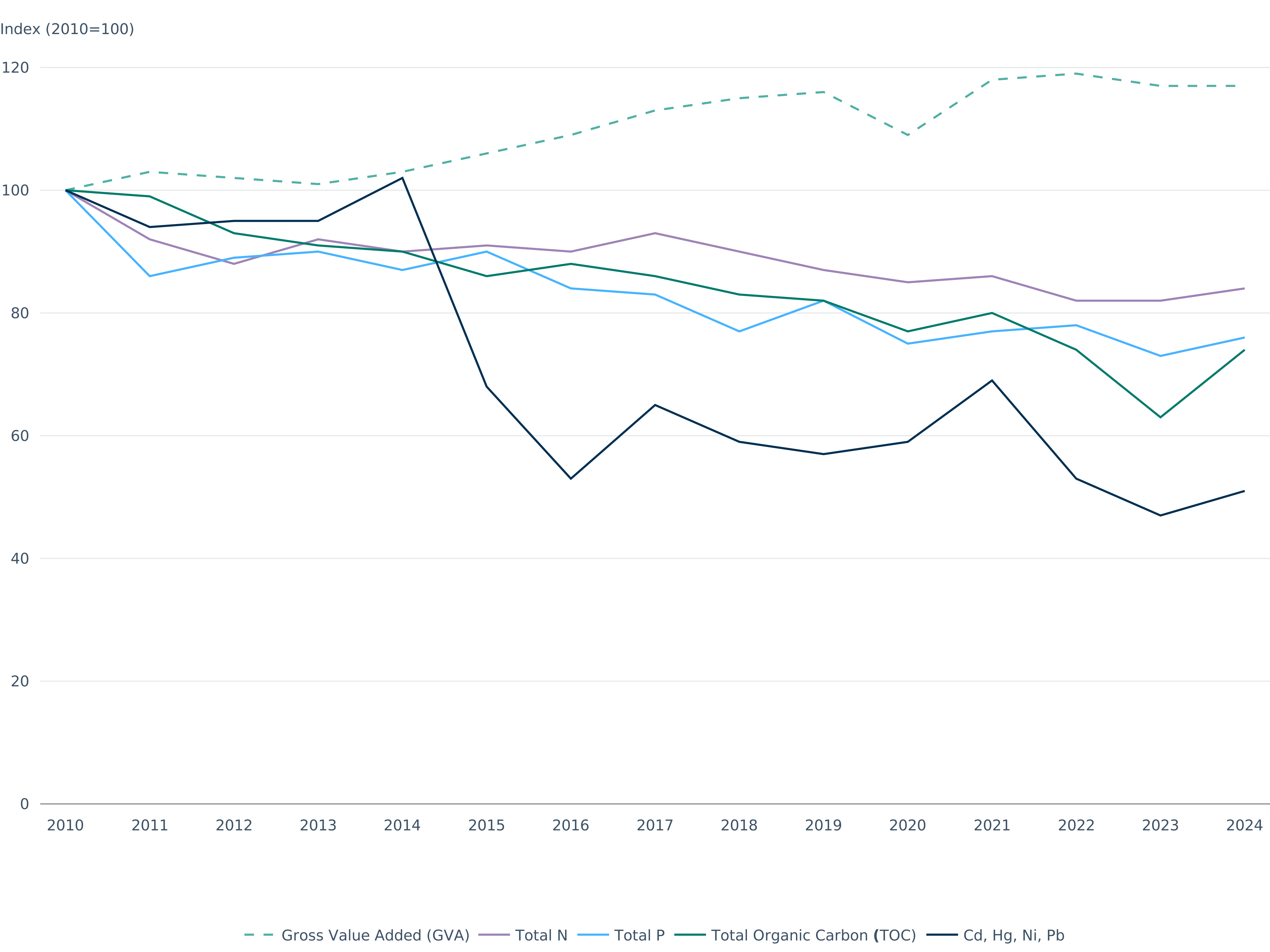
- EU legislation has successfully contributed to mitigating industrial pollution; in the last 10 to 15 years releases of key air pollutants from industry have more than halved.
- Progress has also been made on industrial resource efficiency; since 2010, the EU′s manufacturing sector generates significantly more economic value for each unit of water and raw material consumed.
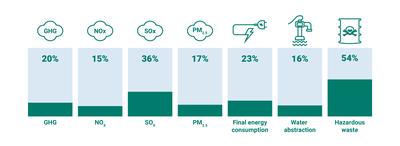
- Despite progress, industry as a whole is a significant contributor to the EU′s environmental and climate pressures, which in some areas are growing. As such Europe needs to urgently scale clean industrial transformation, while harnessing its benefits for strategic autonomy, resilience and long-term competitiveness.
- While industrial resource efficiency has improved, the manufacturing sectors total water use is broadly unchanged since 2010, despite growing concerns over water scarcity and resource dependency. In addition, the EU′s material footprint is above global average and circularity rates have stagnated.
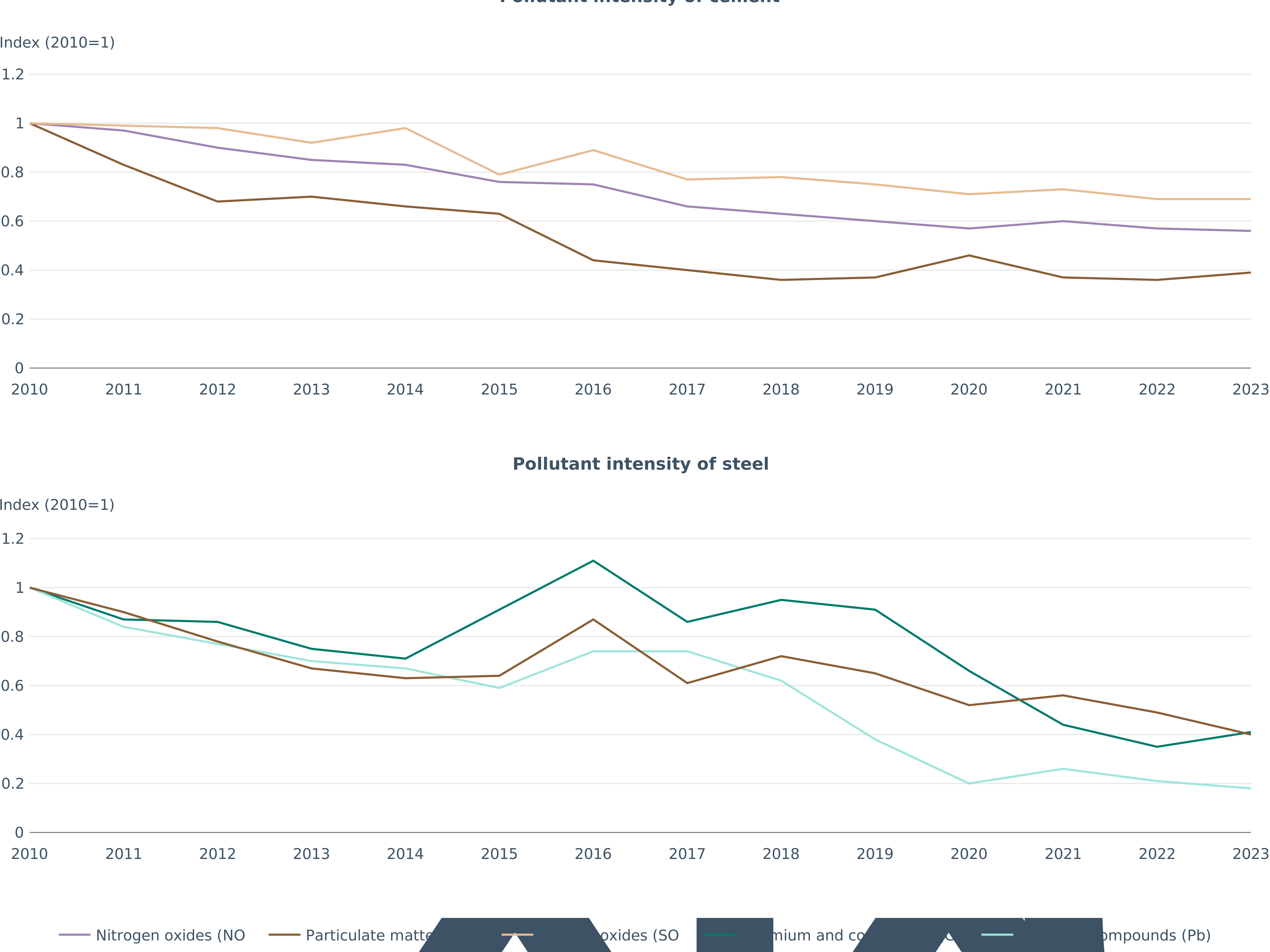
- Further, while total greenhouse gas (GHG) emissions have fallen substantially across industrial sectors, looking at emissions per tonne of product presents a less positive picture. For high-emitting sectors such as cement, and iron and steel, CO2 emissions per tonne of product produced have seen only marginal change or decline during the last 15 years, indicating that much of emission reductions to date has not come from fundamental shifts towards decarbonized production processes.
- This evidence suggests that key industrial sectors — particularly energy-intensive industries — have considerable scope to advance their clean transformation; this presents an important opportunity to further support progress towards the EU′s climate goals.
- The main challenge is no longer technology readiness, but system readiness. Despite technological progress, Europe is not on track towards establishing the enabling conditions needed for a clean industrial transformation; funding gaps, insufficient infrastructure, high energy costs, weak demand and supply-chain constraints continue to delay investments and the deployment of low-carbon and circular solutions at scale.
- The deep process changes required to transform energy-intensive industries will need to take place amid intensifying global competition. As a result, environmental regulation, carbon pricing and stronger enabling conditions alone may not be sufficient to steer industry through the transition while maintaining competitiveness.
- A coherent green industrial policy framework presents a critical opportunity for directionality for Europe by aligning competitiveness, environmental and climate objectives. This report argues that such a framework requires a carefully designed and integrated policy approach that balances:
- shielding: protecting industry during the transition;
- scaling: creating markets and scaling up clean solutions;
- restructuring: restructuring and repositioning industry to align its strengths with clean value chains.
Europe can strengthen its industrial competitiveness while cutting climate and environmental pressures, but progress needs to accelerate. A new report from the European Environment Agency (EEA) finds that the transition of key industrial sectors offers opportunity and explores the policies, investments and enabling conditions needed to drive clean, circular and decarbonised production at scale, delivering prosperity.