All official European Union website addresses are in the europa.eu domain.
See all EU institutions and bodies
An official website of the European Union | How do you know?
Environmental information systems
EN


Every six years, European Union (EU) Member States report on national implementation of the EU Invasive Alien Species Regulation 1143/2014 (IAS Regulation). This briefing summarises highlights from the 2019-2024 reporting period on 87 ‘invasive alien species (IAS) of Union concern’ by all EU Member States.
Key messages
IAS of Union concern are present in the environment of all Member States . Hotspots occur mainly in densely populated areas, along rivers and near major transport hubs (e.g. harbours).
More than 300 rapid eradication response actions have resulted in almost 200 successful (full, partial or temporary) eradications of IAS populations.
More than 4,200 management measures have been implemented. More than half have successfully mitigated negative impacts on biodiversity; outcomes of the remaining measures are still pending.
All Member States identified pathways of introduction and spread and have action plans in place; 13 Member States have also established lists of IAS of national concern.
Despite progress, increased efforts are required as IAS continue to spread in the EU and new species are likely to be introduced
Status, introduction and reproductive patterns of IAS of Union concern
IAS that have an adverse impact requiring concerted action at the EU level (pursuant to Article 4(3) of the IAS Regulation) are referred to as 'Invasive alien species of Union concern’. There are 88 species on the list of IAS of Union concern for the 2019-2024 reporting period: 47 animals, 40 plants and one brown alga (Implementing Regulations 2016/1141, 2017/1263, 2019/1262 and 2022/1203).
The oriental bittersweet Celastrus orbiculatus is included in the list with effect from 2 August 2027 and therefore, is excluded from this reporting period. Most of the reported species occur in terrestrial (47 species) or freshwater (27 species) environments. A few occur in both and one occurs in the marine environment.
The number of IAS present in the environment in each Member State varies from eight to 52. In total, 73 IAS of Union concern are reported as present in the environment in at least one Member State. Permits have been issued for a further four to 15 species by those Member States that have a permit system in place, and these IAS are kept in contained holdings.
The number of IAS present in the environment within the reporting period but now confirmed absent varies from one to six in 16 Member States. More dashboards on status, introduction and reproductive patterns of IAS of Union concern can be found on Biodiversity Information System for Europe.
As previously observed, there is a north-south and an east-west gradient in the numbers of IAS in the EU (EEA, 2012). Numbers are higher in the south and west, which probably is due to a climatic gradient, points of introduction, transportation networks, population density, and to some degree – recording bias.
Map 1. Numbers of IAS of Union concern present in the Member State’s environment
Hotspots of distribution in the EU
There are IAS hotspots, meaning large numbers of different IAS present in the same area, in the Atlantic biogeographical region, particularly along valleys and rivers, and in cities and transportation hubs (e.g. harbours). The numbers of different IAS present in the same areas are smaller in the Boreal biogeographical region and on islands. However, there are some gaps in the reported distributional data, which may partly obscure distribution patterns.
Map 2. Hotspots of IAS distribution in the EU
Widespread species
The most widespread species in the environment are listed below:
- pond slider (Trachemys scripta), reported by 26 Member States;
- tree-of-heaven (Ailanthus altissima), reported by 24 Member States;
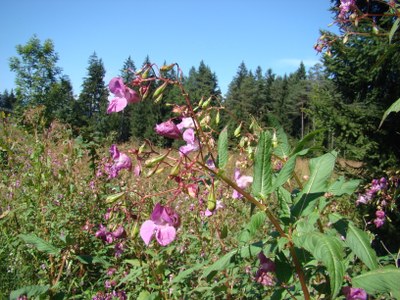
- Himalayan balsam (Impatiens glandulifera), reported by 23 Member States;
- signal crayfish (Pacifastacus leniusculus), reported by 22 Member States;
- pumpkinseed (Lepomis gibbosus), reported by 22 Member States.
- giant hogweed (Heracleum mantegazzianum), reported by 21 Member States;
Rare and absent species
A total of 11 species is only reported in one Member State. In some cases, they are only present in a single locality or very few localities. These species may no longer meet the temporal criteria for rapid eradication under the IAS Regulation; however, they remain suitable candidates for complete eradication efforts by Member States.
Reproduction status
A total of 69 IAS of Union concern have become established in the environment, meaning they have self-sustaining populations in at least one Member State. However, most of them still have a limited distribution with reported occurrences in only one (11 species) or two to five (23 species) Member States. Three species — Himalayan balsam (Impatiens glandulifera), pumpkinseed (Lepomis gibbosus) and signal crayfish (Pacifastacus leniusculus) — are reported as being established in more than 20 Member States.
Figure 1. Numbers of established IAS of Union concern across Member States
Introduction and spread patterns
Overall, 68 IAS of Union concern (78%) were introduced into the EU before the reporting period, i.e. before 2019. Natural dispersal from a neighbouring Member State was reported as the pathway of introduction for more than 30% of the species.
Comparison of occurrence records between the two reporting periods indicates that some species have continued to spread in recent years, whereas others have spread less. Such comparisons can only be made for species listed in both reporting periods and can be found here.
Maps 3a and 3b show two animal species that have continued to spread from central Europe in all directions: the Egyptian goose (Alopochen aegyptiacus) and the northern raccoon (Procyon lotor).
Maps 3c and 3d show two plant species that have continued to spread from a more regional distribution pattern: common milkweed (Asclepias syriaca) and Nuttall's waterweed (Elodea nuttallii).
Maps 3e and 3f show the spread of the Chinese mitten crab (Eriocheir sinensis), a brackish water species that has increased in distribution along the coast, and of the Asian hornet (Vespa velutina nigrithorax), an insect species that has slowly been spreading in all directions.
Maps 3a-f. Comparison of the presence of selected IAS of Union concern in the previous (2015-2018) and current (2019-2024) reporting periods
Rapid eradication measures
It is generally accepted that if prevention fails, early warning and rapid responses are the most efficient management strategies (IPBES, 2023). During the reporting period, 23 Member States undertook more than 300 individual rapid eradication actions, targeting 54 IAS of Union concern. Of these, 188 (60%) were fully, partially or temporarily successful. This represents an increase from 14 Member States implementing such measures in the previous reporting period.
The effectiveness of 78 (25%) of the measures is unknown and requires follow-up, while only 47 (15%) measures had no effect. These data indicate that rapid eradication is more often successful than not and should be attempted whenever feasible.
Management measures
Within the reporting period, 25 Member States undertook more than 4,200 individual management actions targeting 61 IAS of Union concern. Of these:
- more than 1,400 (33%) resulted in complete, partial or temporary eradication;
- more than 300 (8%) resulted in successful containment;
- more than 300 (8%) resulted in successful control.
For almost half of the activities (more than 1,800; 44%), the outcome is still pending and requires follow-up. One Member State targeted 42 different species in the reporting period, but most Member States implemented management measures for only a few species. Management measures were undertaken across most EU biogeographical regions and Member States.
Figure 2. Number of Member States that undertook rapid eradication and management measures and the corresponding number of IAS of Union concern that were targeted by those measures
Permits and inspections
Overall, 19 Member States issued permits for between 2 and 57 IAS of Union concern. These cover 70 different species for purposes such as research, ex situ conservation, scientific production or other activities for which authorisation is required.
A total of 11 Member States issued permits for the African clawed frog (Xenopus laevis), 10 Member States for the pond slider (Trachemys scripta) and nine Member States for the signal crayfish (Pacifastacus leniusculus). Permits were issued not only for species currently present in holdings as required from the IAS Regulation, but also for species that were present in the environment during the reporting period.
Not all establishments have been inspected for compliance. Additionally, in some cases there were discrepancies between authorised and actual specimen numbers. This highlights the need for more rigorous and diligent inspection and control mechanisms in Member States.
Pathways
All Member States prioritised at least one pathway of introduction and spread within their territory. Priority pathways are identified according to the volume of species entering or the potential damage caused by the species in the EU.
The most common pathways are categorised as ‘Escape from confinement’. These include the escape or release of pet, aquarium or terrarium species alongside the spread of species used for ornamental purposes.
Within the ‘Transport’ categories, the pathways ‘Unintentional transport with habitat material’, ‘Hitchhikers on ships/boats’ and ‘Unintentional transport of species attached to angling/fishing equipment’ are the most frequently targeted by measures from Member States.
Figure 3. Numbers of prioritised pathways per pathway category
IAS of Member State concern
Overall, 13 Member States established national lists of IAS of concern for their territory, comprising between 1 and 170 species. These lists can include IAS that are native to one part of the EU but have been introduced elsewhere. Examples include the zebra mussel (Dreissena polymorpha) and the quagga mussel (Dreissena bugensis). They also include species that were proposed for listing as being of Union concern but were not included, such as the brown bullhead (Ameiurus nebulosus) and the large-leaved lupine (Lupinus polyphyllus).
Different management options apply for these species. Member States put in place a range of measures to respond to these IAS. These include restrictions on their introduction into the Member State, placing them on the market and limiting their reproduction, including through control, containment or eradication.
Conclusion and outlook
EU Regulation 1143/2014 aims to prevent, minimise and mitigate the adverse impacts of invasive alien species on biodiversity and ecosystems within the European Union. Reported data from Member States show that significant progress has been made in the implementation of the Regulation, particularly for early warning and rapid response measures and the pathway action plan obligations. However, increasing efforts are required to reduce the spread and negative impacts from widespread invasive alien species.
EEA Briefing 13/2026:
Title: Recent progress in managing invasive alien species in the EU
HTML: TH-01-26-027-EN-Q - ISBN: 978-92-9480-779-3 - ISSN: 2467-3196 - doi: 10.2800/7829183
The European Environment Agency (EEA) would like to thank its partners from the European Environment Information and Observation Network, EEA member countries and European Topic Centre for Biodiversity and Ecosystems, the European Commission Joint Research Centre (https://easin.jrc.ec.europa.eu/easin) and the European Commission Directorate General for Environment for their valuable contributions and input.
EEA, 2012, Invasive alien species indicators in Europe — a review of Streamlining European Biodiversity (SEBI) Indicator 10, EEA Report No 15/2012, European Environment Agency (https://www.eea.europa.eu/en/analysis/publications/streamlining-european-biodiversity-indicators-sebi) accessed 5 April 2026.
Eionet, 2025, ‘Reference portal for reporting under the IAS regulation’ (https://cdr.eionet.europa.eu/help/ias_regulation) accessed 5 April 2026.
EU, 2014, Regulation (EU) No 1143/2014 of the European Parliament and of the Council of 22 October 2014 on the prevention and management of the introduction and spread of invasive alien species (OJ L 317, 4.11.2014, pp. 35-55).
EU, 2016, Commission Implementing Regulation (EU) 2016/1141 of 13 July 2016 adopting a list of invasive alien species of Union concern pursuant to Regulation (EU) No 1143/2014 of the European Parliament and of the Council (OJ L 189, 14.7.2016, pp. 4-8).
EU, 2017, Commission Implementing Regulation (EU) 2017/1263 of 12 July 2017 updating the list of invasive alien species of Union concern established by Implementing Regulation (EU) 2016/1141 pursuant to Regulation (EU) No 1143/2014 of the European Parliament and of the Council (OJ L 182, 13.7.2017, pp. 37-39).
EU, 2019, Commission Implementing Regulation (EU) 2019/1262 of 25 July 2019 amending Implementing Regulation (EU) 2016/1141 to update the list of invasive alien species of Union concern (OJ L 199, 26.7.2019, pp. 1-4).
EU, 2022, Commission Implementing Regulation (EU) 2019/1262 of 25 July 2019 amending Implementing Regulation (EU) 2016/1141 to update the list of invasive alien species of Union concern (OJ L 199, 26.7.2019, pp. 1-4).
IPBES, 2023, IPBES Invasive Alien Species Assessment: Summary for Policymakers, Intergovernmental Science-Policy Platform on Biodiversity and Ecosystem Services (https://doi.org/10.5281/zenodo.7430692) accessed 5 April 2026.
Reportnet 3 Dataflows Invasive Alien Species reporting 2019-2024: Information pursuant to paragraph 1 of Article 24 or Regulation (EU) No 1143/2014 on the prevention and management of the introduction and spread of invasive alien species (https://reportnet.europa.eu/dataflow/1528)
- According to the IAS Regulation, Member States shall establish a permit system allowing establishments to carry out research on or ex situ conservation of IAS of Union concern. A ‘contained holding’ refers to a closed facility from which organisms cannot escape or spread.↵
- Article 17 of the IAS Regulation states that rapid eradication measures should be undertaken within three months of detecting the introduction or presence of an IAS of Union concern. IAS of Union concern found to be widely distributed across a Member State’s territory should be addressed by management measures (Article 19 of the IAS Regulation).↵
- A total of 48 species (EU, 2016, 2017) of Union concern were on the IAS list at the reporting deadline on 1 June 2019. The raccoon dog Nyctereutes procyonoides was added to the list on 2 February 2019 but was excluded from the report as it was added after the end of the first reporting period.↵
- Successful eradication means that the management measures have effectively eradicated the target population. Complete eradication means the complete and permanent removal of all individuals, partially eradicated means that there was a reduction in the number of individuals, but some still present, and temporarily eradicated means that individuals reinvaded the area after successful eradication.↵
- Successful ccontainment means that management measures have effectively contained the entire target population.↵
- Successful control means that management measures have effectively maintained the target population or its associated impacts at or below the desired threshold.↵
- According to Article 8 of the IAS Regulation 1143/2014, Member States shall establish a permit system allowing establishments to carry out research on, or ex - situ conservation of, IAS of Union concern.↵
- According to Article 13 of the IAS Regulation, Member States must carry out a comprehensive analysis of the pathways of unintentional introduction and spread, identify the pathways that require priority action and establish and implement action plan(s) to address the priority pathways.↵
More than 300 rapid eradication actions have been carried out across the EU, with nearly two thirds proving successful — yet invasive alien species continue to spread and new introductions remain likely, shows a European Environment Agency (EEA) briefing published today.