All official European Union website addresses are in the europa.eu domain.
See all EU institutions and bodies
An official website of the European Union | How do you know?
Environmental information systems
EN


EEA report 10/2026
This report explores the challenges and opportunities that could shape the EU′s competitiveness up to 2040. It examines sustainable competitiveness through four interrelated dimensions: circularity and resource efficiency; decarbonisation and electrification; climate adaptation and resilience; nature protection and restoration.
EN PDF: TH-01-26-041-EN-N - ISBN: 978-92-9480-793-9 - ISSN: 1977-8449 - doi: 10.2800/6434558
Key messages
- Europe′s competitiveness is being reshaped by geopolitical fragmentation, technological change, climate impacts, environmental degradation and growing competition for energy and critical resources. Past sources of competitive advantage cannot be taken for granted, and Europe′s current economic performance provides only a partial indication of its capacity to prosper under increasingly uncertain future conditions.
- Europe′s long-term competitiveness depends not only on productivity, investment and innovation but also on maintaining the natural, social and institutional foundations of prosperity. Circularity and resource efficiency, decarbonisation and electrification, climate adaptation and resilience as well as nature protection and restoration can reduce strategic vulnerabilities, protect productive capacity and create opportunities for innovation, investment and employment. This is the basis for becoming competitive by nature.
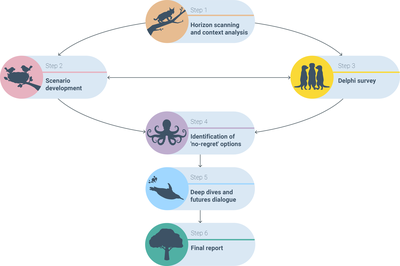
- This report identifies six no-regret options that hold potential for Europe′s sustainable competitiveness across a range of future conditions. These are:
– scaling up circular economy approaches and resource efficiency;
– investing in climate adaptation, nature-based solutions and resilient infrastructure;
– developing European capabilities in computing, artificial intelligence (AI) and next-generation biotechnology;
– strengthening skills, education and lifelong learning;
– supporting social cohesion, public trust and effective regulatory frameworks;
– maintaining an active European Union (EU) role in international standard-setting and multilateral institutions.
- These no-regret options are potentially robust strategic directions. They are deeply interconnected, and their effects will depend on policy design and implementation. In order to realise their potential:
– synergies will need to be strengthened;
– trade-offs will need to be managed;
– it will be necessary to prevent environmental, economic and social risks from being shifted between sectors, places and generations.
- Europe already has a substantial policy foundation supporting these directions. The strategic challenge is therefore to connect, scale up and adapt the existing efforts while maintaining a long‑term perspective — creating economic value while protecting and strengthening the foundations on which Europe′s future prosperity depends.
Europe faces an increasingly competitive and uncertain global environment, shaped by geopolitical change, technological disruption and growing exposure to climate and environmental risks. What strategic choices can Europe make today to remain prosperous, resilient and competitive towards 2040? A new European Environment Agency (EEA) report explores the forces likely to shape Europe’s future and identifies six ‘no-regret’ options that could strengthen its long-term competitiveness.