All official European Union website addresses are in the europa.eu domain.
See all EU institutions and bodies
An official website of the European Union | How do you know?
Environmental information systems
EN

- БългарскиBG
- češtinaCS
- HrvatskiHR
- danskDA
- NederlandsNL
- ελληνικάEL
- EnglishEN
- eestiET
- SuomiFI
- FrançaisFR
- DeutschDE
- magyarHU
- ÍslenskaIS
- italianoIT
- LatviešuLV
- lietuviųLT
- MaltiMT
- NorskNO
- polskiPL
- PortuguêsPT
- RomânăRO
- slovenčinaSK
- SlovenščinaSL
- EspañolES
- SvenskaSV
- TürkçeTR

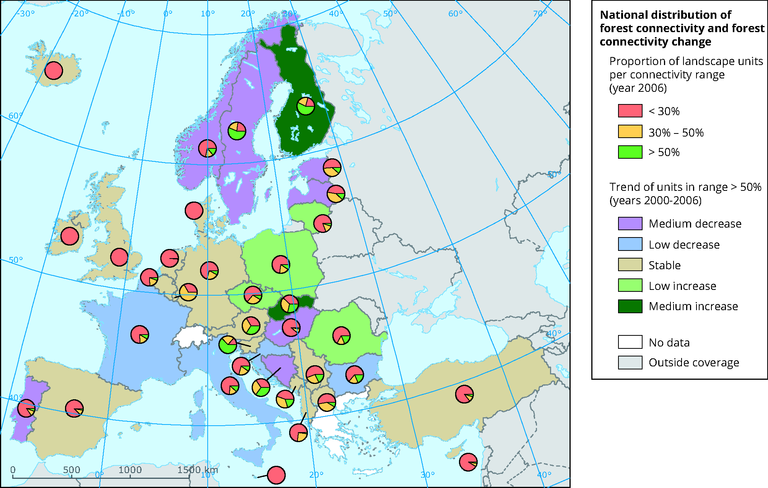
National distribution of forest connectivity for year 2006 and forest connectivity change in the period 2000-2006
Map (static)
The map show the proportion of landscape units per connectivity range reported by country for the year 2006.
The trend (medium/low increase/decrease or stable) in the proportion of units in a high connectivity range (above 50%) is given for the period 2000-2006 per country.
Species dispersing is 1 km.
Downloads
Data sources
Metadata
More info
Loading
- Landscape mosaic pattern maps raster data years 2000 and 2006
Albania, Austria, Belgium, Bosnia and Herzegovina, Bulgaria, Croatia, Cyprus, Czechia, Denmark, Estonia, Finland, France, Germany, Hungary, Iceland, Ireland, Italy, Kosovo (UNSCR 1244/99), Latvia, Lithuania, Luxembourg, Malta, Montenegro, Netherlands, Norway, Poland, Portugal, Romania, Serbia, Slovakia, Slovenia, Spain, Sweden, Switzerland, North Macedonia, Turkey, United Kingdom
2000-2006
Methodology
Methodology for the calculation: forest lands include Corine Land Cover (CLC) classes Broad-leaved forest (3.1.1), Coniferous forest (3.1.2) and Mixed forest (3.1.3), young plantations when 500 subjects/ha and transitional woodland when canopy closure is higher than 50 %. A forest connectivity index (Estreguil et al., 2012, 2013) is calculated per landscape units of 25 km x 25 km for forest dwelling species dispersing in average 1 km. Landscapes including woods have a varying connectivity index from above 0% (few woodlands and highly isolated) to 100% (all woods maximally connected). The pie charts show per country the proportion of landscape units in three connectivity ranges (below 30%; 30-50% ; above 50%). The change of the proportion of landscape units with forest highly connected (above 50%) is also reported per country for the period 2000-2006.
Units
Proportion of landscape units per 3 forest connectivity ranges and trends of units for connectivity range >50
Additional information
How to read the map:
The proportion of landscape units per connectivity ranges is reported by country for the year 2006. The trend (medium/low increase/decrease or stable) of the proportion of units in a high connectivity range (above 50%) is given for the period 2000-2006 per country. Estonia and Lithuania, two countries with the same amount of forests (2.2 million ha), exhibit a different landscape distribution per connectivity ranges (81% of landscapes with poorly connected woodlands in Lithuania versus 51% in Estonia). In the period 2000-2006, landscapes with well-connected forest lands (connectivity above 50%) tended to increase in Lithuania but to decrease in Estonia.
Source: European Commission-Joint Research Centre (JRC); Estreguil et al., 2012