All official European Union website addresses are in the europa.eu domain.
See all EU institutions and bodies
An official website of the European Union | How do you know?
Environmental information systems
EN


The European Climate Law lays down the overall objective for Europe’s economy and society to become climate-neutral by 2050. By that time, EU-wide GHG emissions and removals regulated by EU law need to be balanced. Afterwards, the EU shall aim to achieve negative emissions.
To achieve climate neutrality requires to cut GHG emissions in all EU countries and all economic sectors. This can be achieved by investing in green technologies and protecting the natural environment.
To make sure that EU countries start activities early enough, the law sets an intermediate target for 2030 of reducing net GHG emissions by at least 55% compared to 1990 levels.
Four key legal instruments
- Thesets common rules for planning, reporting, and monitoring on all subjects relevant to achieving the Union’s climate and energy targets.
- The EU Emissions Trading System requires polluters to pay for their greenhouse gas (GHG) emissions. It covers about 40% of total GHG emissions in the EU including emissions from the electricity and heat generation, industrial manufacturing and aviation.
- The Effort Sharing Regulation is in place to reduce GHG emissions from Transport, Buildings, Agriculture, and Waste. National targets for Member States under the ESR will collectively contribute to an emission reduction at EU level of 40% compared to 2005 levels.
- The LULUCF Regulationfocuses on emissions and removals occurring on agricultural land, in forests and through other land uses and land use changes. Like the ESR it includes national targets for net GHG emissions and removals that in total add up to -310 Mt CO2 by 2030.
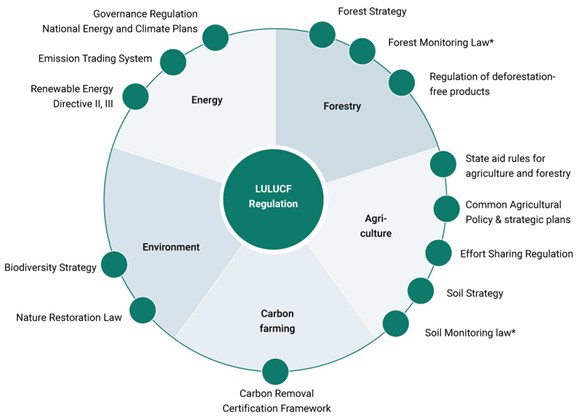
How the LULUCF Regulation works together with other EU policies
The land sector relates to various ecosystems and economic activities that depend on land and its associated services. Consequently, the LULUCF Regulation has connections and synergies with many other EU policy involve land use.
Explore the different policies and find out how they relate to the land sector and the LULUCF Regulation.
Land related policies
1. Common Agricultural Policy
2. Governance Regulation and National Energy and Climate Plans
3. Effort Sharing Regulation
4. Carbon Removal and Carbon Farming Regulation
5. State aid rules for the agricultural and forestry sectors
6. Renewable Energy Directive
7. Biodiversity Strategy and Nature Restoration Regulation
8. Soil Strategy and Soil Monitoring Law
9. Regulation on deforestation-free products
Handbook on the updated LULUCF Regulation EU 2018/841 - Guidance and orientation for the implementation of the updated regulation.