All official European Union website addresses are in the europa.eu domain.
See all EU institutions and bodies- БългарскиBG
- češtinaCS
- HrvatskiHR
- danskDA
- NederlandsNL
- ελληνικάEL
- EnglishEN
- eestiET
- SuomiFI
- FrançaisFR
- DeutschDE
- magyarHU
- ÍslenskaIS
- italianoIT
- LatviešuLV
- lietuviųLT
- MaltiMT
- NorskNO
- polskiPL
- PortuguêsPT
- RomânăRO
- slovenčinaSK
- SlovenščinaSL
- EspañolES
- SvenskaSV
- TürkçeTR
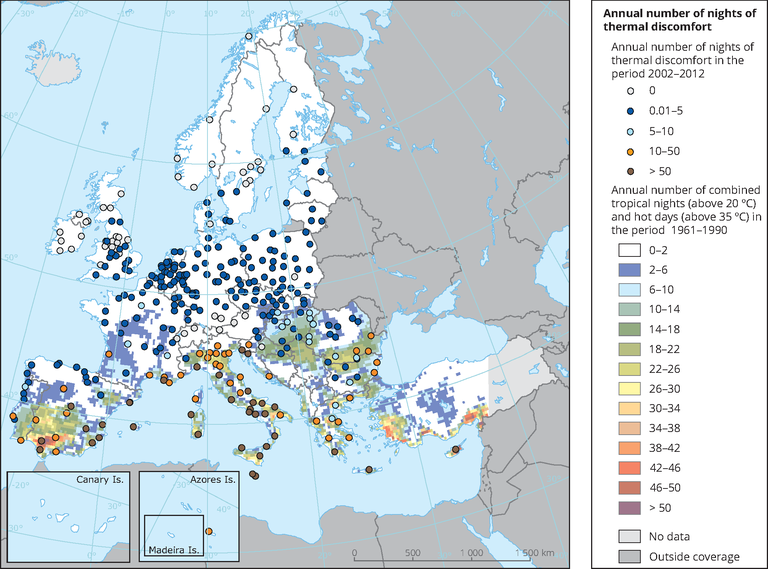
Annual number of nights of thermal discomfort
Map (static)
The map shows that southern cities can experience daytime conditions that represent slight to moderate heat stress at the very least. Many southern cities have also a high share of elderly people. The map does not yet show future projections of thermal discomfort in cities, although it is expected that discomfort in more northern cities will increase.
- Gridded meteorological observations (station data) (present day)
- Population on 1 January by age group and sex - cities and greater cities (urb_cpop1)
- Albania
- Austria
- Belgium
- Bosnia and Herzegovina
- Bulgaria
- Croatia
- Cyprus
- Czechia
- Denmark
- Estonia
- Finland
- France
- Germany
- Greece
- Hungary
- Iceland
- Ireland
- Italy
- Kosovo (UNSCR 1244/99)
- Latvia
- Liechtenstein
- Lithuania
- Luxembourg
- North Macedonia
- Malta
- Montenegro
- Netherlands
- Norway
- Poland
- Portugal
- Romania
- Serbia
- Slovakia
- Slovenia
- Spain
- Sweden
- Switzerland
- Turkey
- United Kingdom
Methodology
As a proxis for Thermal discomfort the map uses the effective temperature.It combines air temperature (°C), relative humidity of the air (%) and the average wind speed (m/s). The outcome is one number per city of nights of thermal discomfort shown as a coloured symbol on the map. To compare with rural areas the map of Fischer and Schär. 2010 on the number of combined hot days and tropical nights as an indicator for heat days is included as a background map. http://climate-adapt.eea.europa.eu/documents/18/0/Factsheets+for+urban+vulnerability+map+book/5e7895f4-4b42-4e61-b04b-e250407cf6dd
Additional information
The mean number of hot days combined with tropical nights increases southward. In the future, it is expected that the number of such days will grow across Europe. In cities, this effect is intensified further due to the urban heat island effect.
Whether citizens feel comfortable or not depends not only on the actual air temperature, but also on the complex interaction of several physical, physiological, behavioural, and psychological factors. The Thermal Comfort Index attempts to capture these relations and the comfort/discomfort levels they generate. From a health perspective, thermal comfort at night is crucial, as the human body needs to maintain reasonable levels for sleep and rest. The mortality risk, particularly among elderly, young and sick people increases with thermal discomfort.
