All official European Union website addresses are in the europa.eu domain.
See all EU institutions and bodies
An official website of the European Union | How do you know?
Environmental information systems
EN


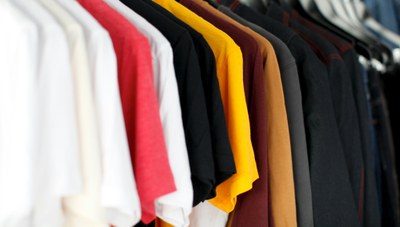
In 2025, 95% of the textiles brought in for repair in a European Repair Café which reports its repairs in the ‘Repair Monitor’, could successfully be repaired. Although this is a higher share of successful repairs compared to the previous two years, overall, there is a declining trend since the first logging of repairs in 2017.
In 2025, a total of 3,157 textile items were brought in for repair at one of the 168 Repair Cafés located across eight EU countries. These Repair Cafés log their activities in the ‘Repair Monitor’, an online tool developed by the Repair Café International Foundation to collect, share, and analyse data on repairs carried out at Repair Cafés. Of the items brought in, 3,000 were successfully repaired, corresponding to a repair success rate of 95%. While this represents a slight increase compared to the previous two years, 94% in 2023 and 93% in 2024, there has been an overall declining trend in repair success rates since data collection began in 2017.
Regarding the types of textile products repaired, trousers and pants, as well as coats and jackets, were the most frequently brought in items, together accounting for 45% of all textile products repaired in 2025. Trousers and pants had a repair success rate of 97%, while 94% of coats and jackets were successfully repaired. Among the most commonly repaired textile products, cardigans had the lowest success rate, at 93%.
In addition to recording the type of product and repair outcome, the Repair Monitor also logs the difficulty of each repair. Analysis of these data shows that the proportion of repairs classified as ‘(rather) difficult’ has increased over time. In 2025, 8% of all repairs were logged as (rather) difficult, compared to 4% in 2017. Tears or holes are the type of defects that are more frequently reported to be (rather) difficult to repair compared to other type of defects. This type of defects is caused by a combination of material properties, construction choices, usage and care, and are partly linked to garment quality.
Continue browsing in the Circularity Metric Lab by visiting one of these thematic modules: