All official European Union website addresses are in the europa.eu domain.
See all EU institutions and bodies
Do something for our planet, print this page only if needed. Even a small action can make an enormous difference when millions of people do it!

Over the years, the EU has adopted a suite of legislation that aims to protect and manage European waters. This started in 1975 with a directive on surface water quality for drinking water abstraction (75/440/EEC; EEC, 1975) followed by the first Bathing Water Directive (BWD, 76/160/EEC; EEC, 1976), followed by the first Groundwater Directive in 1979 (80/68/EEC; EEC, 1979), and the first Drinking Water Directive (DWD, 80/778/EEC; EEC 1980). In the 1990s, the Nitrates Directive (NiD, 91/676/EEC; EC, 1991b), and the Urban Waste Water Treatment Directive (UWWTD, 91/271/EEC; EC, 1991a) came into force. The UWWTD, BWD and DWD continued to focus on protecting human health, whereas the NiD targeted agriculture as the source of emissions, to protect aquatic resources.
The quality of drinking water and bathing water, and the effectiveness of waste water treatment across the European Union continues to improve, according to the European Environment Agency (EEA) report published 2016. However, pollution from sources like waste water treatment plants, agricultural runoff and storm water overflows, and emerging risks like micro pollutants from personal care products pose challenges to maintaining clean and healthy water for people's use.
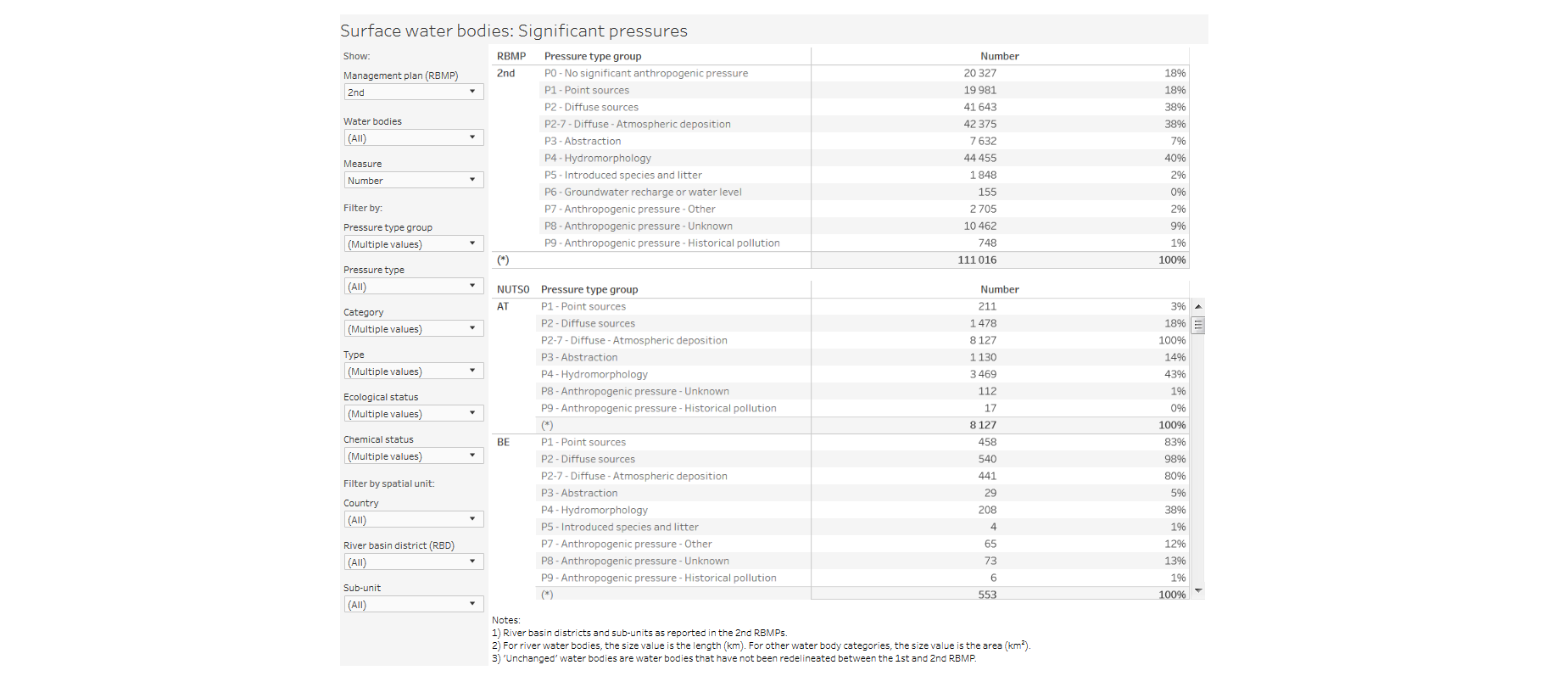
The Water Framework Directive (WFD, 2000/60/EC; EC, 2000) introduced a more holistic approach to ecosystem-based management in 2000. It focuses on the multiple relationships between the many different causes of pollution and their various impacts on water in a river basin. The WFD aims to ensure that human use of water is compatible with the environment's own needs. The WFD requires the identification of significant pressures from point sources of pollution, diffuse sources of pollution, modifications of flow regimes through abstractions or regulation and morphological alterations, as well as any other pressures. 'Significant' means that the pressure contributes to an impact that may result in failing to meet the requirements of Article 4(1) Environmental Objectives (of not having at least good status). In some cases, the pressure from several drivers, e.g. water abstraction from agriculture and households, may in combination be significant. Further dashboards are available below.
Pressures and impacts dashboard
Despite the fact that renewable water is abundant in Europe, signals from long-term climate and hydrological assessments, including on population dynamics, indicate that there was 24 % decrease in renewable water resources per capita across Europe between 1960 and 2010, particularly in southern Europe.
The densely populated river basins in different parts of Europe, which correspond to 11 % of the total area of Europe, continue to be hotspots for water stress conditions, and, in the summer of 2014, there were 86 million inhabitants in these areas.
Around 40 % of the inhabitants in the Mediterranean region lived under water stress conditions in the summer of 2014.
Groundwater resources and rivers continue to be affected by overexploitation in many parts of Europe, especially in the western and eastern European basins.
A positive development is that water abstraction decreased by around 7 % between 2002 and 2014.
Agriculture is still the main pressure on renewable water resources. In the spring of 2014, this sector used 66 % of the total water used in Europe. Around 80 % of total water abstraction for agriculture occurred in the Mediterranean region. The total irrigated area in southern Europe increased by 12 % between 2002 and 2014, but the total harvested agricultural production decreased by 36 % in the same period in this region.
On average, water supply for households per capita is around 102 L/person per day in Europe, which means that there is 'no water stress'. However, water scarcity conditions created by population growth and urbanisation, including tourism, have particularly affected small Mediterranean islands and highly populated areas in recent years.
Because of the huge volumes of water abstracted for hydropower and cooling, the hydromorphology and natural hydrological regimes of rivers and lakes continue to be altered.
The targets set in the water scarcity roadmap, as well as the key objectives of the Seventh Environment Action Programme in the context of water quantity, were not achieved in Europe for the years 2002–2014.
Freshwater abstraction by source in 2015
Water scarcity occurs where there are insufficient water resources to satisfy long-term average requirements. It refers to long-term water imbalances, combining low water availability with a level of water demand exceeding the supply capacity of the natural system.
Water scarcity is driven primarily by two factors:
Although water scarcity often happens in areas with low rainfall, human activities add to the problems in particular in areas with high population density, tourist inflow, intensive agriculture and water demanding industries.
Water scarcity prevails in a number of European river basins, with different water stress levels, affecting around 15-25 % of total European territory. Water scarcity is frequently experienced in the southern and western parts of Europe. More than half of southern Europe lives incessantly under water scarcity conditions, of which agriculture and public water supply, including in relation to tourism, are the main drivers. Particularly in spring and summer, water scarcity in southern Europe prevails and the outer boundaries of this scarcity are expanding. Because of very intensive irrigation in Middle Appenines and the Po Basin (Italy), Guadiana (Portugal and Spain), Segura (Spain), severe water stress is experienced throughout almost the entire year.
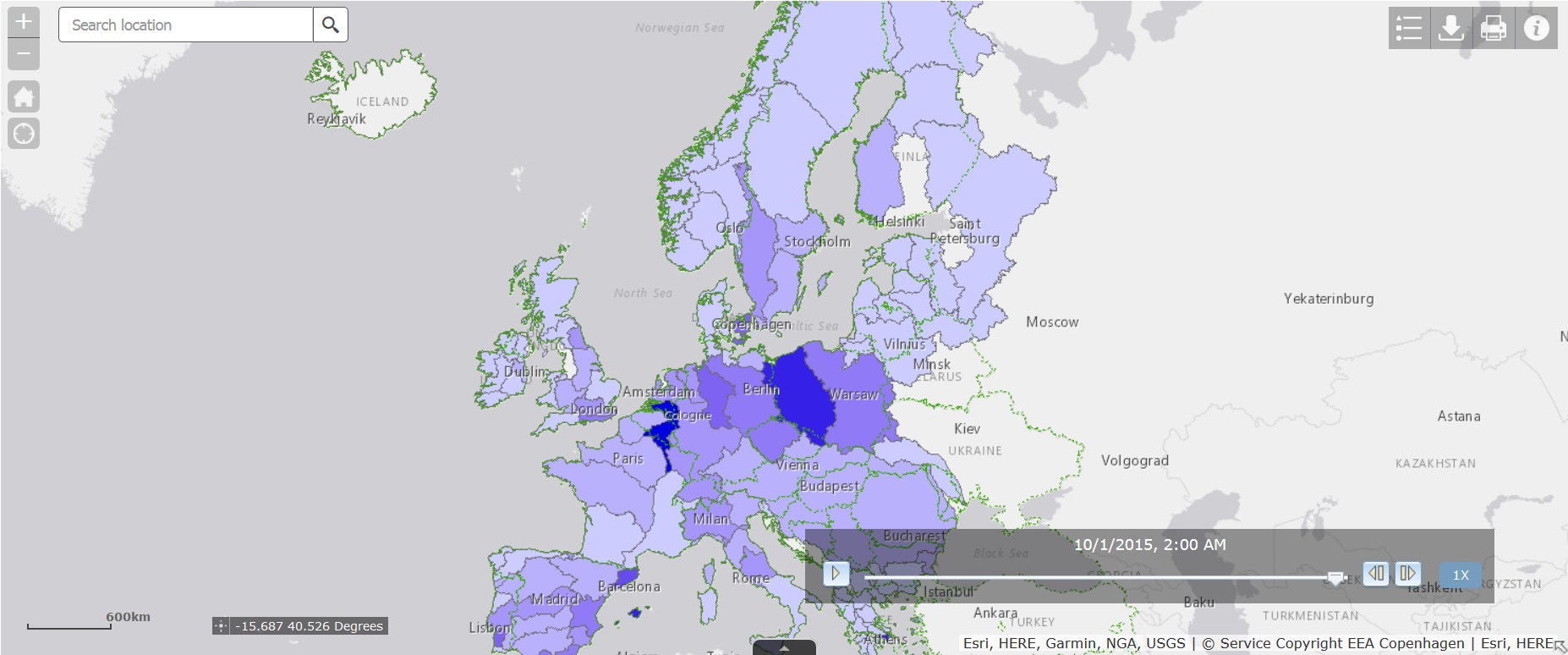
The water exploitation index plus (WEI+), as an indicator of water scarcity, aims to illustrate the percentage of total renewable freshwater resources used in a defined territory (basin, sub-basin, etc.) in a given period (e.g. seasonally, annually). Values above 20 % indicate that water resources are under stress, and above 40 % indicate severe stress and a clearly unsustainable use of freshwater resources (Raskin et al., 1997).
The Water Exploitation Index Plus (WEI+)
Water is a key resource for our quality of life, the things we grow and produce. It also provides natural habitats and eco-systems for Europe's plant and animal species.
Access to clean water for drinking and sanitary purposes is a precondition for human health and well-being. Most people in Europe have access to drinking water of good quality. However, in some parts the quality still frequently does not meet basic biological and chemical standards. Clean unpolluted water is also essential for our ecosystems. Plants and animals in lakes, rivers, transitional and coastal waters react to changes in their environment caused by changes in chemical water quality and physical disturbance of their habitat. Changes in species composition of biological quality elements can be caused by changes in natural conditions like climate but it can also indicate changes in water quality caused by eutrophication, organic pollution, hazardous substances, oil etc..
Almost all human activities can and do impact adversely upon the water. Water quality is influenced by both direct point source and diffuse pollution which come from urban and rural populations, atmospheric depositions, industrial emissions, mining, agricultural activities etc. Diffuse pollution from agricultural activities and point source pollution from sewage treatment and industrial discharge are principal sources. For agriculture, the key pollutants include nutrients, pesticides, sediment and faecal microbes. Oxygen consuming substances and hazardous chemicals are more associated with point source discharges.
Point sources, such as discharges from the treatment of urban wastewater, industry and fish farms are defined as stationary locations or fixed facilities from which pollutants are discharged.
Discharges from wastewater treatment plants and industry cause pollution by oxygen consuming substances, nutrients and hazardous substances. The adverse impacts depend very strongly upon the degree to which (if at all) such discharges are treated before reaching waterways.
Point sources are one of the main pressures on water bodies of Europe. According to 2nd River Basin Management Plans, 18 % of reported surface waterbodies and 14 % of reported groundwater bodies are under the significant pressure of point sources (See Pressure and Impact Dashboards).
In general, discharges of pollutants from point sources have decreased significantly over the past decades. The changes are mainly due to improved purification of urban wastewater and reduced industrial discharges. In western European countries, purification is now very effective and eastern European countries are now following a similar development
The treatment of urban wastewater is fundamental to ensuring public health and environmental protection. Urban waste water treatment in all parts of Europe has improved over recent decades. The proportion of the population connected to waste water treatment plants in northern countries has been above 80 % since 1995, with more than 70 % of urban waste water receiving tertiary treatment. In central European countries, connection rates have increased since 1995 and are now at 97 %, with about 75 % receiving tertiary treatment. The proportion of the population connected to urban waste water treatment in southern, south-eastern and eastern Europe is generally lower than in other parts of Europe, but has increased over the last 10 years with levels now at about 70 %.
The Urban Waste Water Treatment Directive concerns the collection, treatment and discharge of urban waste water and the treatment and discharge of waste water from certain industrial sectors. The objective of the Directive is to protect the environment from the adverse effects of the above mentioned wastewater discharges.
Biochemical oxygen demand (BOD) and ammonium are key indicators of organic pollution in water. BOD shows how much dissolved oxygen is needed for the decomposition of organic matter present in water. Concentrations of these parameters normally increase as a result of organic pollution caused by discharges from waste water treatment plants, industrial effluents and agricultural run-off. Severe organic pollution may lead to rapid de-oxygenation of river water, high concentration of ammonia and disappearance of fish and aquatic invertebrates. Some of the year-to-year variation can be explained by variation in precipitation and runoff.
The most important sources of organic waste load are: household wastewater; industries, such as paper or food processing; and silage effluents and manure from agriculture. Increased industrial and agricultural production in most European countries after the 1940s, coupled with a greater share of the population connected to sewerage systems, initially resulted in increases in the discharge of organic waste into surface water. Over the past 15 to 30 years, however, the biological treatment (secondary treatment) of waste water has increased, and organic discharges have consequently decreased throughout Europe.
Diffuse pollution can be caused by a variety of activities that have no specific point of discharge. Agriculture is a key source of diffuse pollution, but urban land, forestry, atmospheric deposition and rural dwellings can also be important sources.
By its very nature, the management of diffuse pollution is complex and requires the careful analysis and understanding of various natural and anthropogenic processes.
Modern-day agricultural practices often require high levels of fertilizers and manure; leading to high nutrient (e.g. nitrogen and phosphorus) surpluses that are transferred to water bodies through various diffuse processes. Excessive nutrient concentrations in water bodies, however, cause adverse effects by promoting eutrophication, with an associated loss of plant and animal species. In high nutrient waters with sufficient sunlight, algal slimes can cover stream beds, plants can choke channels and blooms of plankton can turn the water murky green. Oxygen depletion, the introduction of toxins or other compounds produced by plants, reduced water clarity and fish kills can also occur. Excess nutrient levels can be detrimental to human health.
Pesticides used in agriculture are transported to both surface and groundwaters. Not only do they threaten both wildlife and human health, the excessive sediment run-off from agricultural land results in turbid waters and the clogging of spawning areas. This in turn leads to loss of aquatic habitats. Microbial pathogens from animal faeces can pose a significant risk to public and animal health. High concentrations can restrict the recreational and water supply uses of water, cause illness and loss of productivity in cattle, and limit shellfish aquaculture in estuaries.
The adverse impacts of all these agricultural pollutants are exacerbated by the use of water for agriculture (primarily irrigation); the net effect of which is to increase the concentration of pollutants in water bodies. The presence of nutrients, pesticides, sediment and faecal microbes in water bodies also incurs water treatment costs where abstraction is carried out for the supply of drinking water.
In urban areas, where surface run off is not connected to treatment works, pollutants deposited on to impervious surfaces (e.g. roads or pavements) are washed into nearby surface waters. Such pollutants include metals, pesticides, hydrocarbons, solvents etc and derive from various sources including the atmosphere and the abrasion of roads, tyres and brakes. In some urban areas, surface run off is discharged into sewers, which then mixes with sewage on its way to treatment. During periods of large rainfall, the sewage system is unable to cope with the volume of water. As a result, the flow is directed away from the treatment works and discharged as a combined sewer overflow (CSO) to surface water. This causes pollution from not only sewer waste but also urban runoff. In this respect, urban diffuse pollution ultimately becomes a point source.
Across Europe, diffuse sources and hydromorphological pressures are the main pressures on water bodies. According to 2nd River Basin Management Plans, 38 % of reported surface waterbodies are under significant pressure caused by diffuse sources (See Pressures and impacts dashboard).
Since 2005, average nitrate concentrations in European groundwater have declined and in 2011, the mean concentration had almost returned to the 1992 level. The average nitrate concentration in European rivers declined by 0.03 milligrams per liter of nitrogen (mg N/l) (0.8 %) per year over the period 1992 to 2012. The decline in nitrate concentration reflects the effect of measures to reduce agricultural inputs of nitrate, as well as improvements in wastewater treatment. Average orthophosphate concentration in European rivers has decreased markedly over the last two decades (0.003 milligrams per liter of phosphorous (mg P/l) or 2.1 % per year). Also, average lake phosphorus concentration decreased over the period 1992-2012 (0.0004 mg P/l, or 0.8 % per year). The decrease in phosphorus concentration reflects both improvements in wastewater treatment and the reduction of phosphorus in detergents.
Hydromorphological characterization and assessment of waterbodies are essential to determine waterbodies' ecological status and achieve environmental objectives that are set in Article 4 of the WFD.
According to the WFD, hydrological regimes, continuity (migrant aquatic life such as fish, sediment) and morphological condition for rivers and streams; hydrological regimes and morphological conditions for lakes and tidal regime and morphological conditions for transitional and coastal waterbodies must be monitored and assessed to determine ecological status of waterbodies. This means that any intervention of hydrological regimes of waterbodies like regulation and damming effect and any morphological deterioration and physical changes in waterbodies by anthropogenic activities like dredging, artificial material, channelization, embankment etc. may cause adverse effects on environmental objectives via deterioration of aquatic habitats, which cause loss and change of biological species and composition. Change in hydromorphological status may cause a downgrading in biological status, therefore the hydromorphological quality elements are called “supported quality elements” in the WFD.
Human activities which are called driving forces (agricultural activities, urban development, navigation, flood protection and defense, mineral extraction, energy production, recreational use etc.) cause main hydromorphological pressures on Europe's waterbodies. These driving forces make hydromorphological changes on waterbodies. Pressures sourced from driving forces, such as; water storage, water transfer, channelization, deforestation of riparian buffer zone etc. affect the physical habitat of aquatic life directly. They may also affect the terrestrial habitat, which is in interaction with waterbodies. Because of changing physical characteristics of water body’s shape, boundaries and content, suitable habitats for natural species to live healthily may be disrupted and, depending on this, waterbodies’ status may fail to meet the requirements of the WFD.
A significant number of surface water bodies across Europe are at risk of failing to achieve good ecological status, one of the main objectives of the Water Framework Directive. A high proportion of these water bodies were identified as being at risk or probably at risk because of alterations to their structural characteristics (i.e. their morphological characteristics) and associated impacts on their water flow and level regimes (i.e. their hydrological characteristics). According to 2nd River Basin Management Plans, hydromorphology is the main pressure on Europe’s waterbodies. Across Europe 40 % of reported surface waterbodies are under significant hydromorphological pressure (See Pressure and Impact Dashboards). It is also the case that a specific pressure will not always cause a particular impact. Scale, both temporal and spatial, is one of the issues that will determine the impact of a pressure.
For references, please go to https://www.eea.europa.eu/themes/water/european-waters/water-use-and-environmental-pressures/water-use-and-environmental-pressures or scan the QR code.
PDF generated on 18 May 2025, 11:32 PM
Engineered by: EEA Web Team
Software updated on 26 September 2023 08:13 from version 23.8.18
Software version: EEA Plone KGS 23.9.14
Document Actions
Share with others