All official European Union website addresses are in the europa.eu domain.
See all EU institutions and bodies
Do something for our planet, print this page only if needed. Even a small action can make an enormous difference when millions of people do it!

Figure
 Methodology:
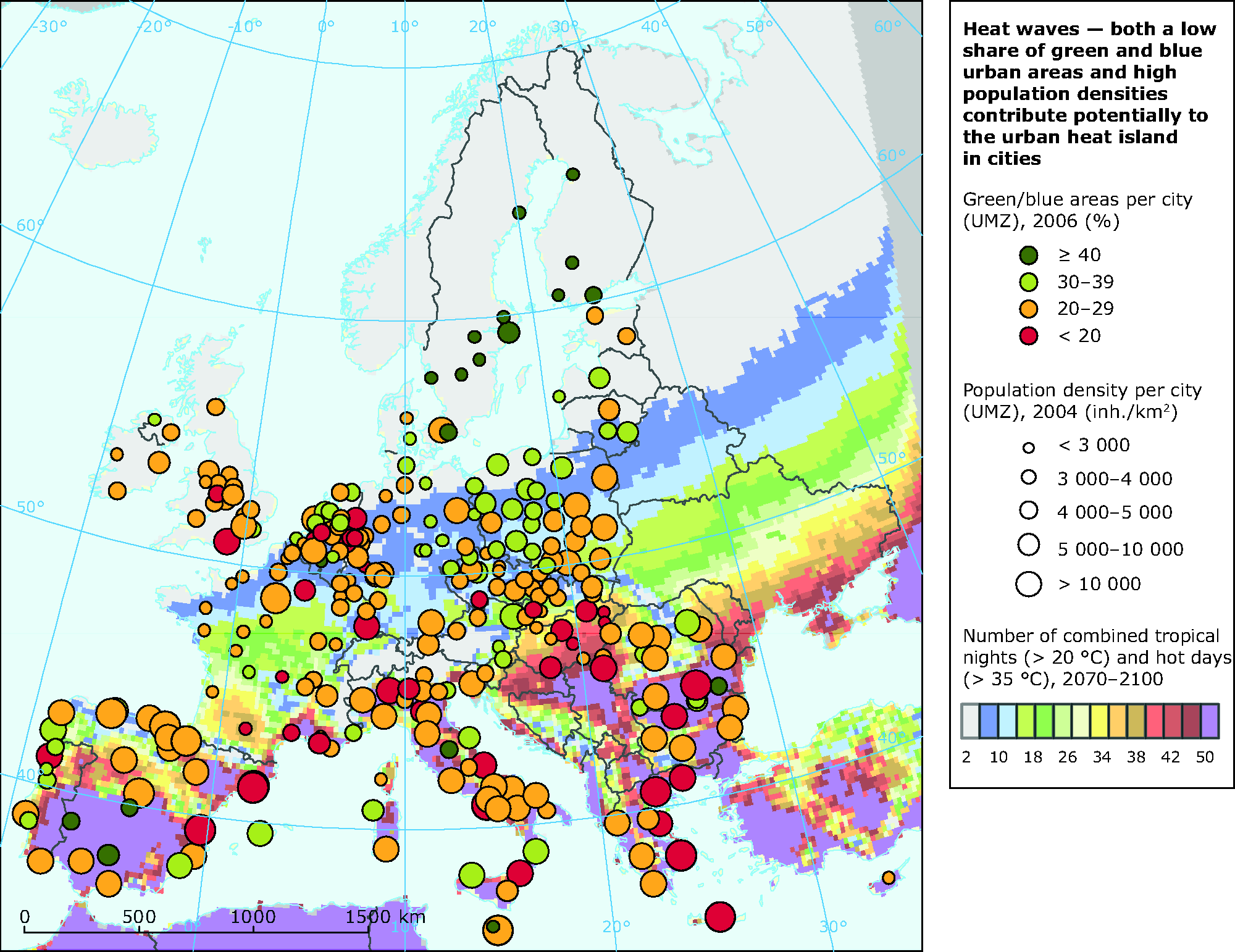
Green (vegetated) and blue (water) urban areas have been extracted from the Urban Atlas product, i.e. values for 369 core cities are available. The considered area is the UMZ inside the core city area (defined in Urban Atlas). The selection of classes contained in the green and blue urban areas is based on their relevance for the Urban Heat Island effect. The following selection has been made, all classes marked in green are components of the green and blue urban areas:
|
CODE |
Urban Atlas classes |
|
11230 |
Discontinuous Low Density Urban Fabric (S.L. : 10% - 30%) |
|
11240 |
Discontinuous Very Low Density Urban Fabric (S.L. < 10%) |
|
14100 |
Green urban areas |
|
14200 |
Sports and leisure facilities |
|
20000 |
Agricultural areas, semi-natural areas and wetlands |
|
30000 |
Forests |
|
50000 |
Water bodies |
Those classes were extracted from the Urban Atlas, their area summed up and its share in relation to the total area of the city (core city-UMZ) calculated. For the map production the values were classified into 4 classes and presented as coloured dots on the map.
The population statistics (total population) have been exported from the Urban Audit database for the reference year 2004 (IE and BG data are from 2001), reprocessed to reflect core city-UMZ related population densities and mapped as dots of different sizes.
Rights:
Owners:
Figure type:
For references, please go to https://www.eea.europa.eu/data-and-maps/figures/heatwaves-2014-both-a-low or scan the QR code.
PDF generated on 26 Apr 2024, 04:10 PM
Engineered by: EEA Web Team
Software updated on 26 September 2023 08:13 from version 23.8.18
Software version: EEA Plone KGS 23.9.14

Document Actions
Share with others