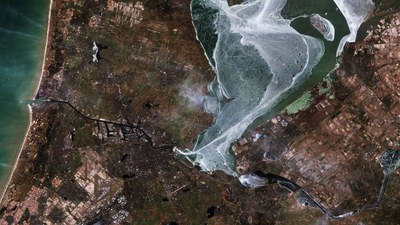
Based on Corine Land Cover 2006, the map shows the distribution of aggregated land cover classes.
Based on Corine Land Cover 2006 and changes between 2000 and 2006, the map shows the land take distribution and intensity for development of urban and other artificial area
Based on Corine Land Cover 2006 and changes between 2000 and 2006, the map shows the distribution and intensity of selected Land Cover Flows (LCF) in agricultural area.
The European inventory of nationally designated areas holds information about protected areas and the national legislative instruments, which directly or indirectly create protected areas.
The map and the graph show the coastal erosion patterns in Europe (2004)
Version 16 (04/2012) - Corine land cover 2000 is the year 2000 update of the first CLC database which was finalised in the early 1990s as part of the European Commission programme to COoRdinate INformation on the Environment (Corine)
Forests in Europe (based on CLC 2006)
Corine land cover 2006 is the latest update of the CLC database as part of the European Commission programme to COoRdinate INformation on the Environment (Corine) started in the early 1990s. It provides consistent information on land cover and its changes during the period 2000-2006 across Europe. The CLC2006 database covers 38 countries.
Hot spot analyses showing density of transitions between urban areas and natural/semi-natural/open and wetland areas, derived from Corine land cover 2006
This simple example uses the data of the NUTS-X regions from Belgium (FG-B2). The effective mesh density (seff) is shown
as the response variable as a function of two predictor variables: population density (PD, between 64 and 600 people
per km2) and gross domestic product per capita (GDPc, between 20 500 and 37 000 euros PPs). The gridded plane shows
the predicted values for the effective mesh density for each combination of PD and GDPc. The differences between the
observed values of seff (shown as small squares) and the predicted values are shown as perpendicular lines and are called
residuals. In this example, the predicted level of fragmentation increases with higher population densities and with higher
gross domestic product per capita, and the variation in population density has a higher influence than the variation in GDPc.
Effective mesh density values by NUTS-X region for Fragmentation Geometry FG-B2 in 2009. The NUTS-X regions represented by points above the diagonal line are more fragmented than predicted (e.g., FR107 Val de Marne) and those represented by by points below the diagonal line are less fragmented than predicted (e.g., CH04 Zurich).
Land take by the expansion of residential areas and construction sites is the main cause of the increase in the coverage of urban land at the European level. Agricultural zones and, to a lesser extent, forests and semi-natural and natural areas, are disappearing in favour of the development of artificial surfaces. This affects biodiversity since it decreases habitats, the living space of a number of species, and fragments the landscapes that support and connect them. The annual land take in 36 European countries was 111 788 ha/year in 2000-2006. In 21 countries covered by both periods (1990-2000 and 2000-2006) the annual land take increased by 9 % in the later period. The composition of land taken areas changed, too. More arable land and permanent crops, forests, grasslands and open spaces and less pastures and mosaic farmland were taken by artificial development then in 1990-2000.
What is the surface covered by forests in Europe? Has this surface increased or decreased between 1990 and 2000? Which of the European countries has got the major increase of artificial surfaces in its coastal area between 1990 and 2000?
The key focus of land cover accounts is the understanding of the way in which the stocks of different land covers change over time. This viewer allows visualising and downloading land cover statistics derived from land accounts applied methodology.
Document Actions
Share with others