All official European Union website addresses are in the europa.eu domain.
See all EU institutions and bodies
Do something for our planet, print this page only if needed. Even a small action can make an enormous difference when millions of people do it!

In general, the fall in emissions during the 1990s was due to a decrease in total fuel consumption caused by the transformation of the national economy, increased energy efficiency and a switch from solid fuels and liquid fuels to natural gas and biomass fuels. In recent years, emission levels have remained relatively stable.
The energy sector is the main source of sulphur dioxide emissions in Latvia.
Domestic heating and the use of solvents and other products represent significant sources of volatile organic compounds (VOCs).
The largest proportion of nitrogen oxide emissions originates from the transport sector (particularly road transport) and the number of registered motor vehicles per 1 000 inhabitants continues to increase (Figure 7).
Almost all NH3 emissions originate from agricultural activity.
Overall, air pollution decreased between 1990 and 2005 − SO2 by 96 %, VOCs by 34 %, and NH3 by 70 % (Figure 8). During this period, the relative influence of the transport sector on nitrogen oxide emissions grew, while the influence of energy production fell by almost 50 %[1].

Figure 7: Number of registered motor vehicles per 1 000 inhabitants
Source: Latvian Environment, Geology and Meteorology Centre
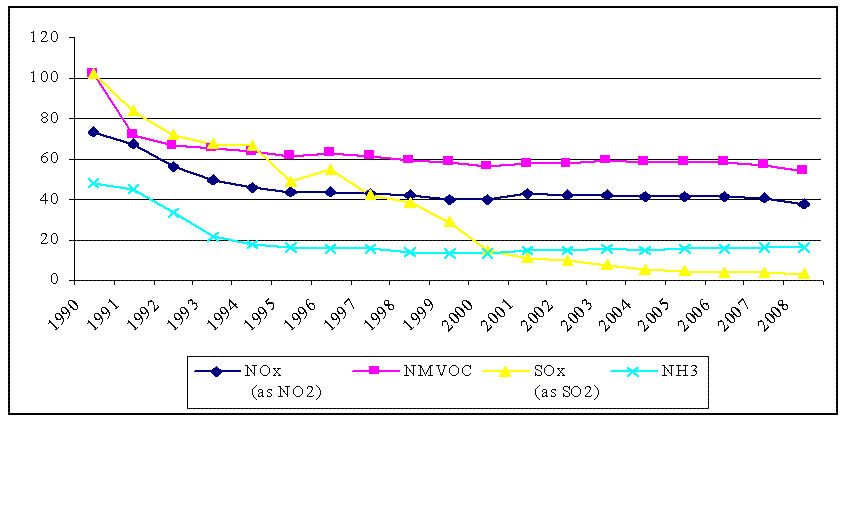
Figure 8: SO2, NOx, NMVOC, NH3 emissions, 1990–2008 (1 000 tonnes)
Source: Latvian Environment, Geology and Meteorology Centre
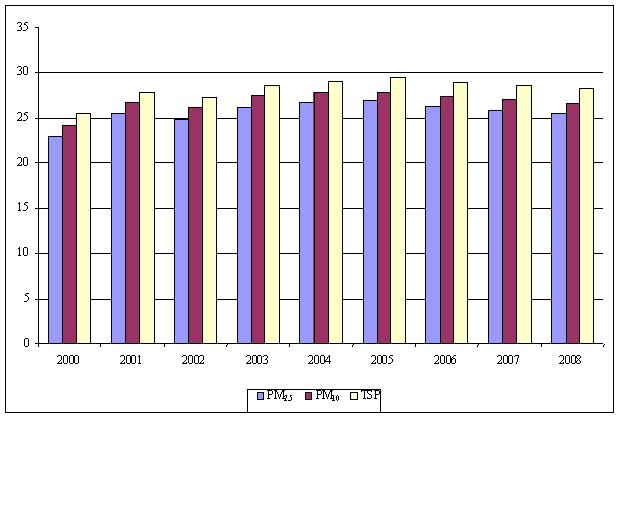
Figure 9: Emissions of particulate matter, 2000–2008 (1 000 tonnes)
Source: Latvian Environment, Geology and
Meteorology Centre
State of the Environment, National Report 2008 [in Latvian]
Sustainable Development Indicators in Latvia 2006 [in Latvian]
[1] Related documents: Informative Report on National Measures to Reduce National Emissions (in Latvian)
For references, please go to https://www.eea.europa.eu/soer/2010/countries/lv/air-pollution-drivers-and-pressures-latvia or scan the QR code.
PDF generated on 27 Apr 2024, 03:06 AM
The country assessments are the sole responsibility of the EEA member and cooperating countries supported by the EEA through guidance, translation and editing.
Engineered by: EEA Web Team
Software updated on 26 September 2023 08:13 from version 23.8.18
Software version: EEA Plone KGS 23.9.14
Document Actions
Share with others