Personal tools

Sign up now!
Get notifications on new reports and products. Currently we have 76299 subscribers. Frequency: 3-4 emails / month.
Follow us
Twitter icon Twitter
Facebook icon Facebook
YouTube icon YouTube channel
RSS logo RSS Feeds
Notifications archive

Write to us Write to us

For the public:


For media and journalists:

Contact EEA staff
Contact the web team
FAQ

Call us Call us

Reception:

Phone: (+45) 33 36 71 00
Fax: (+45) 33 36 71 99


next
previous
items

Skip to content. | Skip to navigation

Sound and independent information
on the environment

You are here: Home / Data and maps / Maps and graphs / Predicted and observed values of effective mesh density according to the pan‑European predictive model

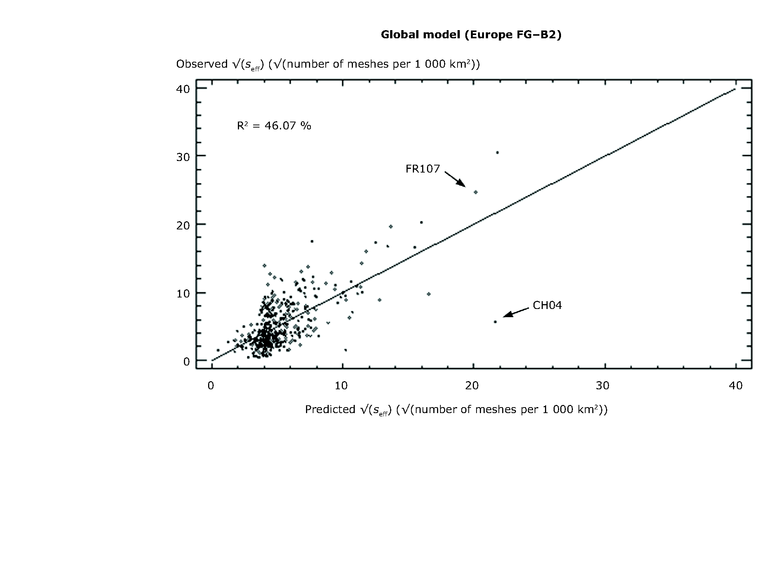
Predicted and observed values of effective mesh density according to the pan‑European predictive model

Created : Sep 26, 2011 Published : Sep 26, 2011 Last modified : Nov 29, 2012 11:36 AM
Topics: ,
Effective mesh density values by NUTS-X region for Fragmentation Geometry FG-B2 in 2009. The NUTS-X regions represented by points above the diagonal line are more fragmented than predicted (e.g., FR107 Val de Marne) and those represented by by points below the diagonal line are less fragmented than predicted (e.g., CH04 Zurich).
This is the latest published version. .

Metadata

Additional information

The model inludes all 10 predictor variables for all NUTS-X regions in Europe, using a square root transformation for seff and PD. The NUTS-X regions represented by points above the diagonal line are more fragmented than predicted (e.g. FR107 Val
de Marne) and those represented by points below the diagonal line are less fragmented than predicted (e.g. CH04 Zurich).
(The five NUTS-X regions with seff > 1 000 meshes per 1 000 km2 were excluded from the analysis: FR101 Paris, FR105
Hauts‑de‑Seine, FR106 Seine-Saint-Denis, UKI1 Inner London, BE10 Région de Bruxelles-Capitale.)

Related content

European Environment Agency (EEA)
Kongens Nytorv 6
1050 Copenhagen K
Denmark
Phone: +45 3336 7100
