Personal tools

Sign up now!
Get notifications on new reports and products. Currently we have 76958 subscribers. Frequency: 3-4 emails / month.
Follow us
Twitter icon Twitter
Facebook icon Facebook
YouTube icon YouTube channel
RSS logo RSS Feeds
Notifications archive

Write to us Write to us

For the public:


For media and journalists:

Contact EEA staff
Contact the web team
FAQ

Call us Call us

Reception:

Phone: (+45) 33 36 71 00
Fax: (+45) 33 36 71 99


next
previous
items

Skip to content. | Skip to navigation

Sound and independent information
on the environment

You are here: Home / Data and maps / Maps and graphs / Malaria in 2050

Malaria in 2050

Created : Dec 10, 2010 Published : Dec 13, 2010 Last modified : Nov 29, 2012 11:36 AM
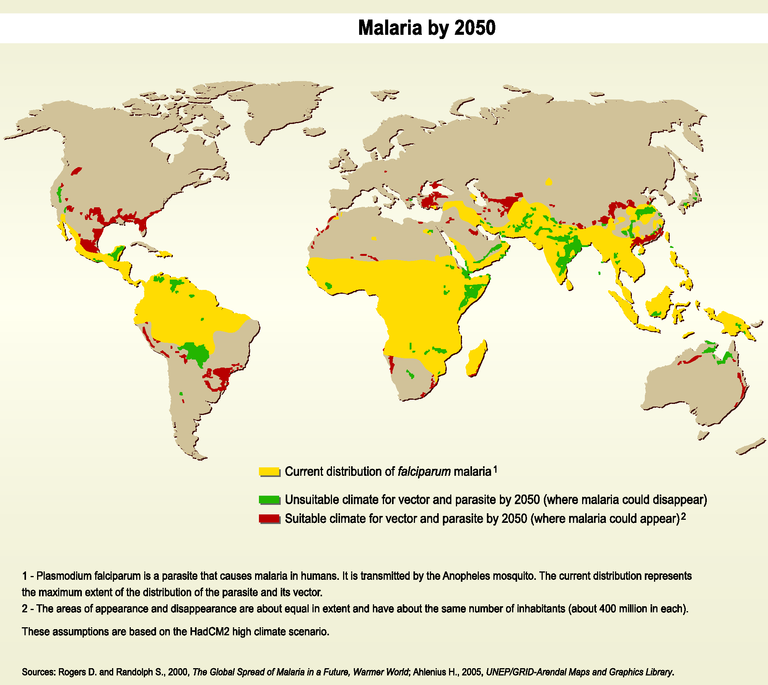
The map shows the current distribution of falciparum malaria (in yellow), areas where it is projected to appear (in red) and disappear (in green) by 2050.
This is the latest published version. .

Metadata

Additional information

This map covers the world.

Plasmodium falciparum is a parasite that causes malaria in humans. It is transmitted by the Anopheles mosquito. The current distribution represents the maximum extent of the distribution of the parasite and its vector. The areas of appearance and disappearance are about equal in extent and have about the same number of inhabitants (about 400 million in each). Assumptions are based on the HadCM2 high climate scenario.

European Environment Agency (EEA)
Kongens Nytorv 6
1050 Copenhagen K
Denmark
Phone: +45 3336 7100
