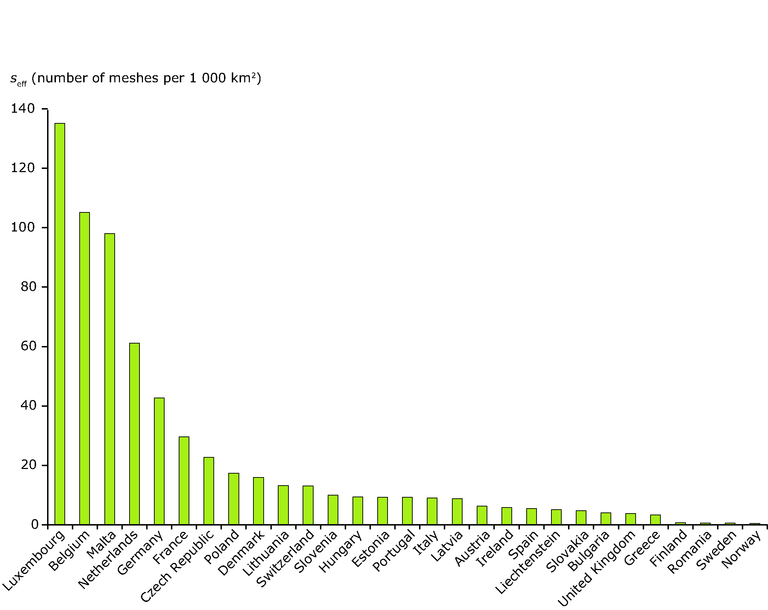
Effective mesh density values by country for Fragmentation Geometry FG-B2 in 2009. Fragmentation geometry has been created from input data (TeleAtlas roads/rails, CLC urban classes, mountain areas / mountain ridges based on Nordregio and WorldClim data and rivers/lakes based on Catchment Characterisation and Modelling (CCM) v.2 database and CLC database) and landscape fragmentation metrics (Jaeger 2000) has been calculated.
EEA standard re-use policy: unless otherwise indicated, re-use of content on the EEA website for commercial or non-commercial purposes is permitted free of charge, provided that the source is acknowledged (http://www.eea.europa.eu/legal/copyright). Copyright holder: Swiss Federal Office for the Environment, Concordia University - Geography, Planning and Environment, European Environment Agency (EEA).
The objective of this task is calculate “effective mesh size” as indicator of landscape fragmentation. Effective mesh size (Meff) is proportional to the probability of two points chosen randomly in region being connected. This probability is then converted into the size of a patch – the effective mesh size. The unit of Meff is that of area (e.g. ha). This area corresponds to the size of “meshes” of regular network that has the same degree of fragmentation and it can be compared with the values of Meff from other regions. The smaller the effective mesh size, the more fragmented the landscape.
Document Actions
Share with others
