All official European Union website addresses are in the europa.eu domain.
See all EU institutions and bodies
Do something for our planet, print this page only if needed. Even a small action can make an enormous difference when millions of people do it!

Figure
 Methodology:
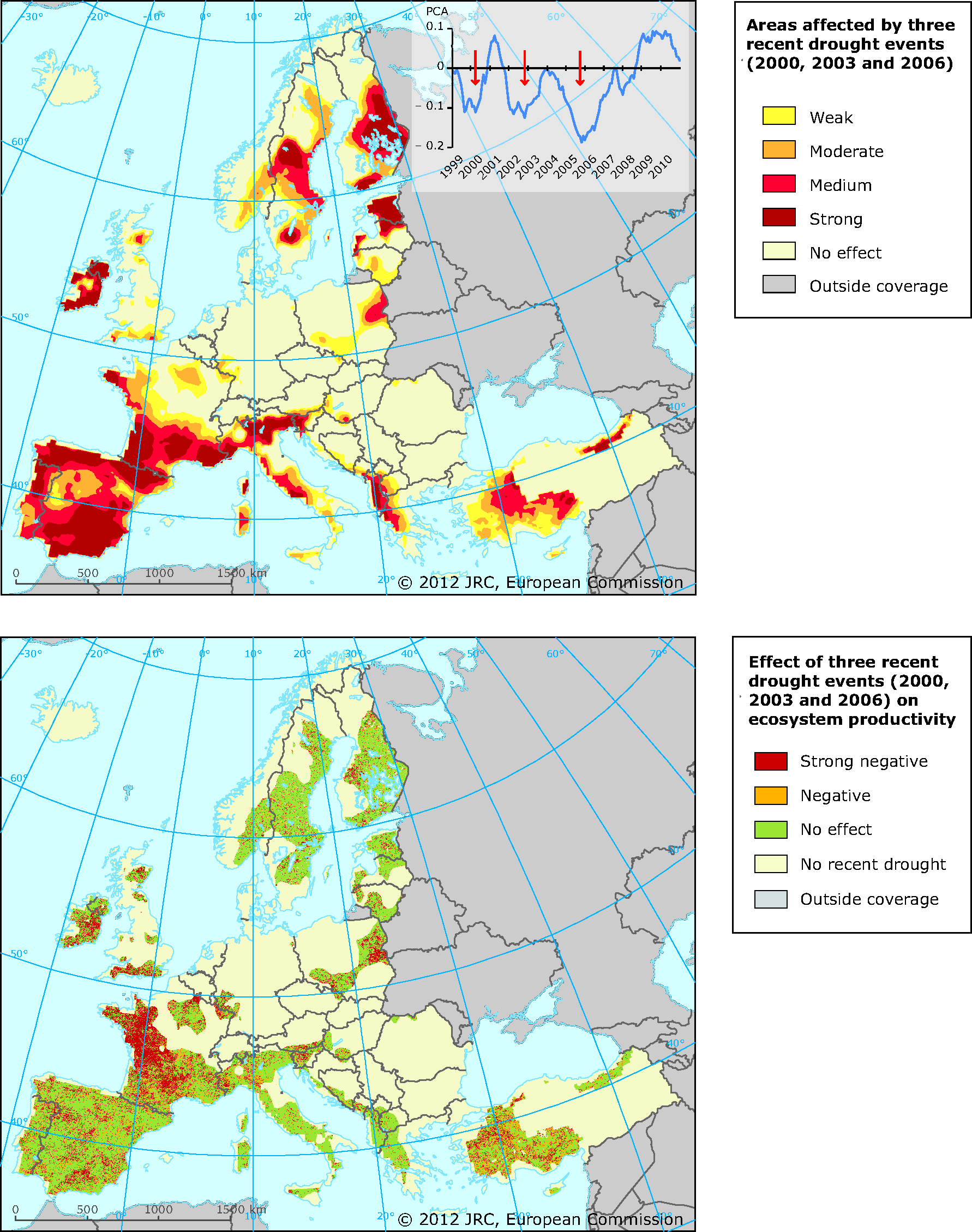
A statistical correlation to recurrent drought anomalies through principal component analysis of time series climatic data.
Units:
Qualitative scale: weak - no effect
Rights:
Owners:
Figure type:
Areas affected by three recurrent negative precipitation anomalies (as indicated in the graph: 2000, 2003 and 2006 during the period 1999-2010 based on the standardised precipitation index, a statistical correlation to recurrent anomalies through principal component analysis (PCA) of time series climatic data). The prevalence of recurrent negative precipitation anomalies in the Mediterranean area is very apparent. Such anomalies can also affect areas with traditionally humid climates.
For references, please go to https://www.eea.europa.eu/data-and-maps/figures/areas-affected-by-three-recurrent or scan the QR code.
PDF generated on 19 Apr 2024, 05:29 PM
Engineered by: EEA Web Team
Software updated on 26 September 2023 08:13 from version 23.8.18
Software version: EEA Plone KGS 23.9.14

Document Actions
Share with others